
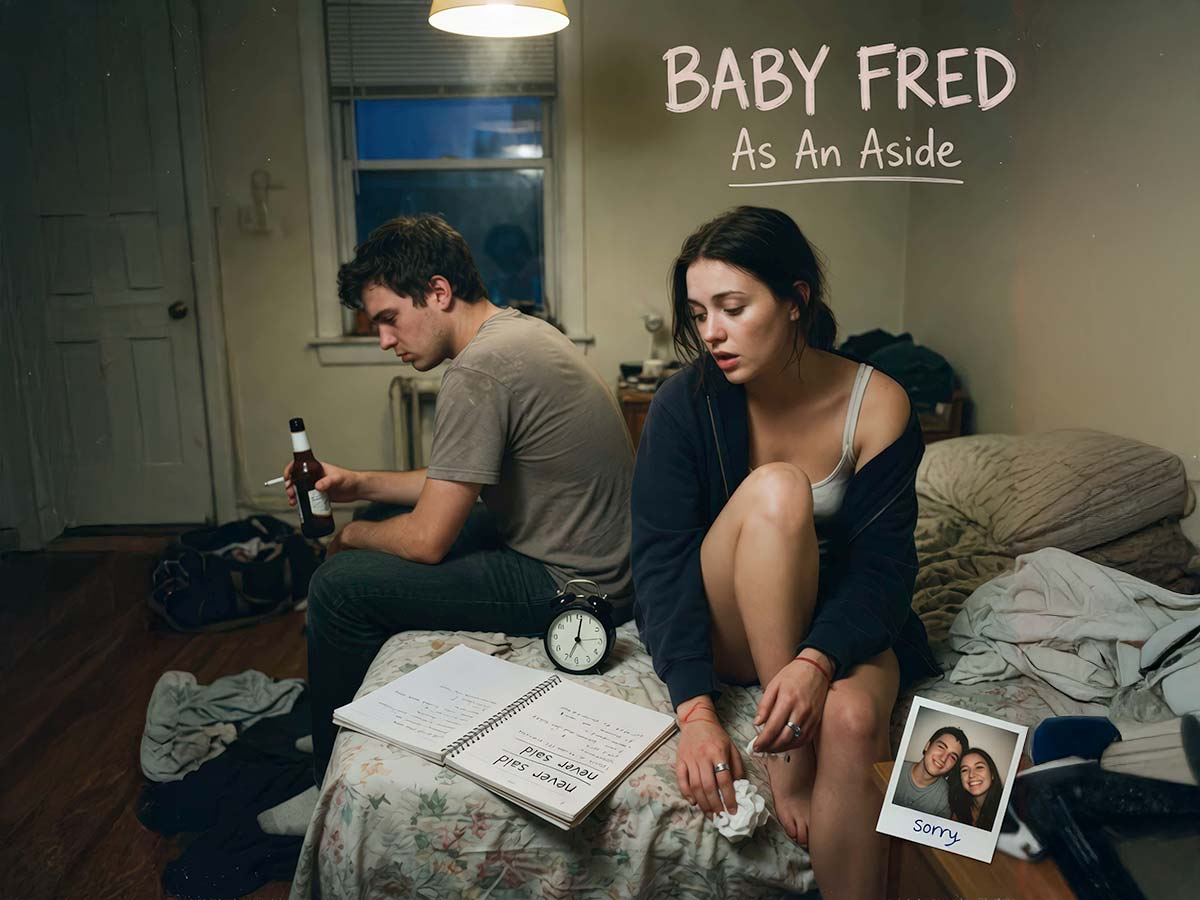
As An Aside
Written by Briyan Frederick and Joe Maki
℗ by Blind Mime Music, ASCAP & Jomah Kai Music, ASCAP
© Briyan Frderick Baker, Joseph Alan Maki. All rights reserved.
babyfredmusic.com
“As An Aside,” written by Briyan Frederick and Joe Maki and released under the Baby Fred name, is a song about the words that almost get said. The lyric circles around confrontation without fully stepping into it, building its emotional force from hesitation, rehearsal, self-protection, and the private violence of keeping quiet. The narrator stands at the edge of saying something brash, crude, raw, possibly unfair, possibly true, and the song lives inside that tension.
The opening line, “If I was one to say these things,” immediately frames the speaker as someone trying to distance himself from his own feelings. He presents the thought as hypothetical. He might say something brash. He might speak without asking for a pass. He might walk into the trap and go all in on the game. The phrasing gives him cover. He can say the thing by pretending he would never say the thing. That is one of the song’s sharpest writing devices: every denial becomes a confession in disguise.
The verses have the feeling of an argument being drafted in the mind. The speaker imagines the confrontation, edits himself, judges himself, and backs away. He knows that if he speaks freely, he may sound crude or wrongheaded. He may become “one more rube,” another fool baited into saying too much. There is a strong sense that the relationship has become a place where language has consequences. A careless phrase could be saved, twisted, repeated later, or used as evidence. The narrator fears the other person’s reaction, but he also fears his own lack of control.
That self-awareness is crucial. The speaker does not cast himself as purely noble or purely wounded. He knows he has “all my faces.” He knows he can talk until he is blue. He knows the fool is inside him. That makes the lyric feel lived-in. A weaker version of this song might have aimed all the blame outward. “As An Aside” keeps turning the knife back toward the narrator. He is hurt, but he also recognizes his part in the mess. He can see the trap and still imagines stepping into it.
The chorus lands with the devastating image at the center of the song: the fear of becoming “the guy you someday mention,” some poor soul brought up casually, “merely yearly and insincerely,” as an aside. That phrase carries the emotional weight of the whole piece. To be remembered “as an aside” means to be reduced. It means the depth of the relationship, the struggle, the feeling, the private history, all collapses into a passing reference. The narrator imagines himself becoming a small anecdote in someone else’s life, a way to release tension in a future conversation.
That is a specific kind of heartbreak. The song is concerned with losing love, but even more with losing significance. The speaker can imagine being left. What wounds him more deeply is the thought that what they were could be retold lightly. “As if all I am and all we have become / Is just undone / As an aside.” Those lines turn the title into a verdict. The relationship has weight for him. He fears it will have almost none for the other person.
The third verse changes the emotional temperature. “But I’m not one to say these things / I’ll hold it in and take the beating.” After two verses of hypothetical speech, the narrator declares his actual pattern: silence. He watches time fleeting. He watches the other person leaving. He talks like he is different, then admits that he is not. That admission is one of the lyric’s strongest moments because it rejects the easy pose of maturity. Silence can look dignified from the outside, but inside the song it feels like fear, exhaustion, and self-betrayal.
“I don’t want the confrontation with the fool / The fool I am will always say / What one might want to say.” Here, the fool is both the person he might confront and the person he sees in himself. The line suggests that the real confrontation is internal. He wants to believe he is above saying the messy, needy, cruel, human thing. Yet he knows those words remain there, waiting for a weak moment.
The bridge opens the song into memory. “A younger me might look away / And pocket these emotions / Mix them in with keys and potions.” The image is wonderful because it turns emotion into small, hidden objects: things carried around, kept close, touched in secret. Keys suggest access, locked rooms, ways in and out. Potions suggest childish magic, the belief that certain objects might change reality if held long enough. The lyric then links little boys and old men, suggesting that age does not automatically cure the habit of hiding pain in one’s pockets.
That moment gives the song a broader emotional reach. The narrator is dealing with a present relationship, but he is also confronting a lifelong pattern. He has been pocketing emotions for years. He has carried them from boyhood into age. The song begins as a near-argument and becomes a character study: a portrait of someone who learned long ago to contain himself, even when containment turns toxic.
The next verse asks the most dangerous question in the song: “So are you one to take these things / And use them all against me.” This is the central fear of intimacy. The narrator wants to be understood, but he worries that understanding will become ammunition. He wants someone to see “the truth somewhere deep within me,” while knowing that truth, once exposed, can be weaponized. That contradiction gives the song its ache. He wants closeness and protection at the same time.
Musically, the lyric invites a performance built around restraint. The repetition of “If I was one to say these things” creates a circling motion, almost like someone pacing in a room, rehearsing variations of the same speech. The verses call for a vocal that feels close, conversational, and slightly worn down by thought. The chorus needs to open emotionally, but without turning triumphant. The pain of the song comes from the fact that even the release remains trapped inside the narrator’s self-consciousness.
If the recording leans into intimacy, the song likely gains power from the small details: a vocal that sounds human rather than polished into distance, an arrangement that leaves enough space for the lyric to breathe, and musical movement that mirrors the pressure building under the narrator’s restraint. A phone, an aside, a future mention, a casual retelling — these are everyday objects and gestures carrying emotional damage. The music should make room for that ordinariness, because the song’s drama comes from how quietly devastating the situation is.
“As An Aside” is effective because it understands how people actually argue with themselves. The narrator does not simply say what he feels. He qualifies it, rehearses it, disowns it, returns to it, and tries to survive the silence that follows. Frederick and Maki write the song from the uncomfortable middle ground where pride, fear, love, resentment, and self-knowledge all speak at once.
By the end, the title has become the wound. The speaker’s greatest fear is that the whole emotional history will someday be flattened into a parenthetical remark. The song refuses that flattening. It gives the aside its full weight. It takes the passing comment and turns it back into a life-sized ache.