
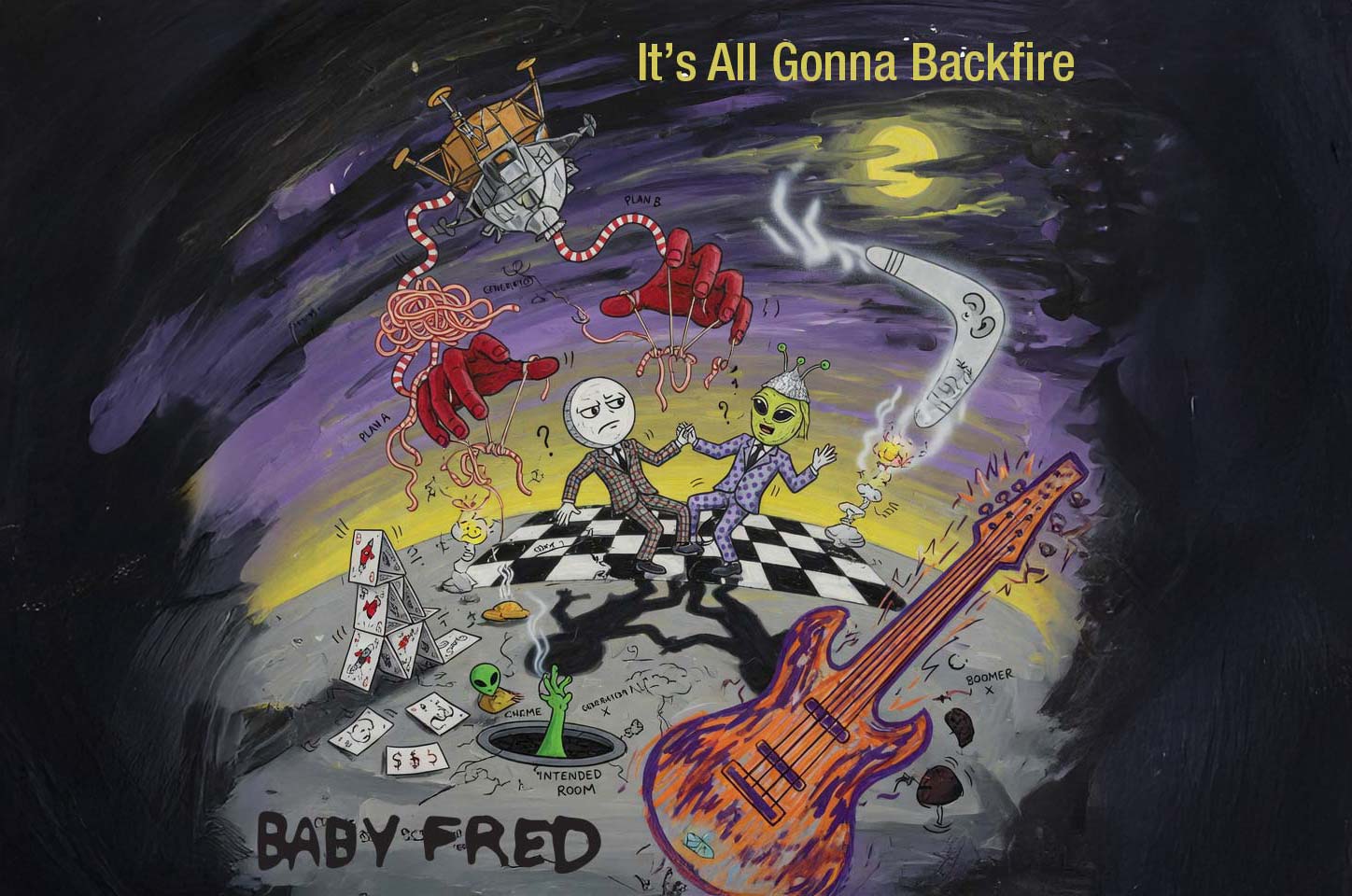
It's All Gonna Backfire
Written by Briyan Frederick Baker and Joe Maki
℗ by Blind Mime Music, ASCAP & Jomah Kai Music, ASCAP
© Briyan Frederick Baker, Joseph Alan Maki. All rights reserved.
Joe Maki: original instrumental track, guitar, bass, drums.
Briyan Frederick: lyric, voice model, sunoai
The best laid plans of boys and men
Can't always plan for what comes down next
Life's a brittle mess of cobwebbed schemes
Patchwork days in diaries
The smartest people in the room
Frolicking up there on the moon
We watched it all in black and white
But now we doubt what's wrong is right
That's what it all comes down to bro
It's not what you do, but who you know
But even then you can't control
[chorus]
When it's all gonna backfire
It's all gonna backfire
On me and you
Our children too
It's all gonnabackfire
Well I got you and and you got me
Let's agree to disagree
On how to face this circumstance
On who will lead this awkward dance
That's what it all comes down to bro
It's not what you do, but who you know
But even then you can't control
[chorus]
When it's all gonna backfire
It's all gonna backfire
On me and you
Our children too
It's all gonnabackfire
[bridge]
Red-handed fools avoiding gazes
Furtive eyes won't show their faces
Or face the fact it's all a a lie
Even the aliens don't know why
The best laid plans of boys and men
Can't always plan for what comes down next
Watch your step, avoid that crack
Or you willbreak your poor, poor mother's back
That's what it all comes down to bro
It's not what you do, but who you know
But even then you can't control
[chorus]
When it's all gonna backfire
It's all gonna backfire
On me and you
Our children too
It's all gonnabackfire
It's all gonna backfire (no matter what we do or say)
It's all gonna backfire …
I tend to start with the title when Joe sends me a track. It’s not a rule, but it’s a habit that’s become a kind of doorway. When he sent over “Backfire,” I didn’t open a notebook right away. I let the word sit there for a while. Backfire. It’s a mechanical failure, a misfire, something that turns against its own intention. It’s also human. Plans that collapse, ideas that rebound, decisions that echo further than they should. I knew if I could find the first verse, I’d find the rest of the song.
“The best laid plans of boys and men / Can’t always plan for what comes down next…”
That line came early, and once it landed, the frame was set. I wasn’t writing a personal confession, not exactly. It felt wider than that—more like stepping back and looking at how we all behave, how we construct these fragile systems of intention and expectation. There’s a kind of social commentary baked into that first verse, even if it’s not declared outright. We like to think we’re in control, that we can anticipate outcomes, that intelligence or status or proximity to power gives us some kind of advantage over chaos. But the lyric doesn’t buy that. It just watches it.
“Life’s a brittle mess of cobwebbed schemes / Patchwork days in diaries…”
Those lines feel observational to me, but I’m not outside of them. That was important as the voice developed. The narrator isn’t standing above it all, pointing fingers. He’s inside the same mess. Both inside and outside at once. There’s no innocence here. That was something I became aware of as I wrote—this idea that no one escapes the consequences, even if they pretend they can.
“The smartest people in the room / Frolicking up there on the moon…”
There’s a bit of bite in that, but also a shrug. We elevate certain voices, certain circles, certain “rooms,” and assume they’ve got it figured out. Meanwhile, everything still wobbles underneath. We used to watch it all in black and white—simpler narratives, cleaner divisions—but now even that certainty has eroded.
“But now we doubt what’s wrong is right…”
That line didn’t feel like a grand statement. It felt like an admission. The ground is less stable than we pretend.
The pre-chorus sharpens that tension into something more direct:
“That’s what it all comes down to bro / It’s not what you do, but who you know…”
There’s a deliberate looseness in that language. The “bro” isn’t accidental. It carries a tone—casual, insider, a little dismissive. Maybe there’s a hint of that Joe Rogan-style conversational shorthand in there, or just the broader culture of inner-circle gamesmanship. It’s a way people talk when they think they understand the system. But the next line undercuts it.
“But even then you can’t control…”
That’s where the confidence slips. Even if you know the right people, even if you’re in the room, even if you think you’re playing the game correctly—there’s still something beyond reach.
The chorus is where everything condenses:
“When it’s all gonna backfire / It’s all gonna backfire / On me and you / Our children too…”
That line—“Our children too”—is probably the center of the song for me. It’s where the idea stops being abstract. It’s not just about us, not just about immediate consequences. It stretches forward. There’s a sense that what we set in motion doesn’t end with us. It carries on, sometimes in ways we can’t predict or even understand. I’ve thought about it as a kind of constant butterfly effect. Every action ripples outward—into the present, into the future, maybe even bending back into the past in ways we don’t fully grasp.
It can sound fatalistic if you read it straight, but I didn’t experience it that way while writing. It’s more like recognition. This is how things behave. Cause and effect doesn’t always move in neat lines. It loops, overlaps, amplifies.
The second verse brings it back down to a more personal scale:
“Well I got you and you got me / Let’s agree to disagree…”
There’s something almost domestic about that. Smaller stakes on the surface, but it’s the same dynamic. How do we move forward when we don’t align? Who leads? Who follows?
“On how to face this circumstance / On who will lead this awkward dance…”
That phrase—“awkward dance”—felt right because it avoids resolution. It doesn’t pretend there’s a clean answer. It just names the movement.
The bridge is where the absurdity comes into sharper focus:
“Red-handed fools avoiding gazes / Furtive eyes won’t show their faces…”
There’s guilt there, or at least awareness. But it doesn’t lead to clarity.
“Or face the fact it’s all a lie / Even the aliens don’t know why…”
That last line is doing a particular kind of work. It leans into humor, but not as a throwaway. Life and people are absurd. The idea that even some imagined outside intelligence—aliens, something beyond us—would look at our behavior and come up empty, that felt like the right level of perspective. We can’t even step outside ourselves far enough to explain what we’re doing. The humor keeps the song from becoming heavy-handed. It lets the weight sit there without collapsing everything.
Musically, Joe’s track already had a strong identity. That blues-based rocker feel, the overdriven guitar, the steady backbeat—it all pointed in a clear direction. When I worked it through in Suno with that indie-rock prompt—bright, slightly crunchy guitar, piano and organ bass filling it out—it clicked into place pretty quickly. The groove carries the lyric in a way that feels almost at odds with the theme. It moves forward confidently, even as the words question that confidence.
There was a moment where I thought about extending the guitar solo, letting it stretch out more. In another version, maybe it would have. But this one landed with a shorter interlude, and I didn’t push it. There wasn’t a big conceptual decision behind that. I just liked what happened and let it be. In a way, that lack of control—accepting the version that showed up—fits the song better than any deliberate shaping might have.
That’s something I’ve come to accept more over time. I’m 64 now. I don’t feel like I have answers in the way I might have once thought I should. What I have is a viewpoint and a voice. That’s what this song ends up being. Not a solution, not a manifesto. Just a way of articulating what it feels like to watch things unfold.
We seem to be moving toward conflict—personally, politically—in ways that don’t always account for the backfire. Or maybe the sense is that the backfire has to be worse than the current reality to justify the risk. I don’t know. I’m not sure there’s much space for cooler heads to step in and slow things down. That uncertainty sits underneath the whole track.
“The best laid plans of boys and men / Can’t always plan for what comes down next…”
By the time that line returns later in the song, it’s less of an observation and more of a quiet refrain. A reminder that whatever we think we’re building, it’s subject to forces we don’t fully control.
“Watch your step, avoid that crack / Or you will break your poor, poor mother’s back…”
There’s a childlike echo in that line, something almost superstitious. Cause and effect reduced to a rhyme, a warning passed down without explanation. It fits alongside the larger theme in a strange way. We’ve always tried to make sense of consequences, to map them onto simple rules. But reality doesn’t always follow those rules.
In the end, “Backfire” exists because I needed to say something without pretending I could resolve it. The chorus keeps coming back:
“When it’s all gonna backfire…”
It doesn’t answer when. It doesn’t say how. It just sits there, looping, like the guitar figure underneath it. Persistent. Unresolved.
“It’s all gonna backfire (no matter what we do or say)…”
That last tag leans a little further into the idea, but even there, it’s not absolute. It’s just another angle on the same uncertainty.
I don’t come out of the song with clarity. I come out of it with recognition. We act, we plan, we argue, we align and misalign, and somewhere in all of that, consequences are already in motion—touching us, touching the people around us, reaching forward into lives we won’t see.
On me and you. Our children too.
Even the aliens don’t know why.