
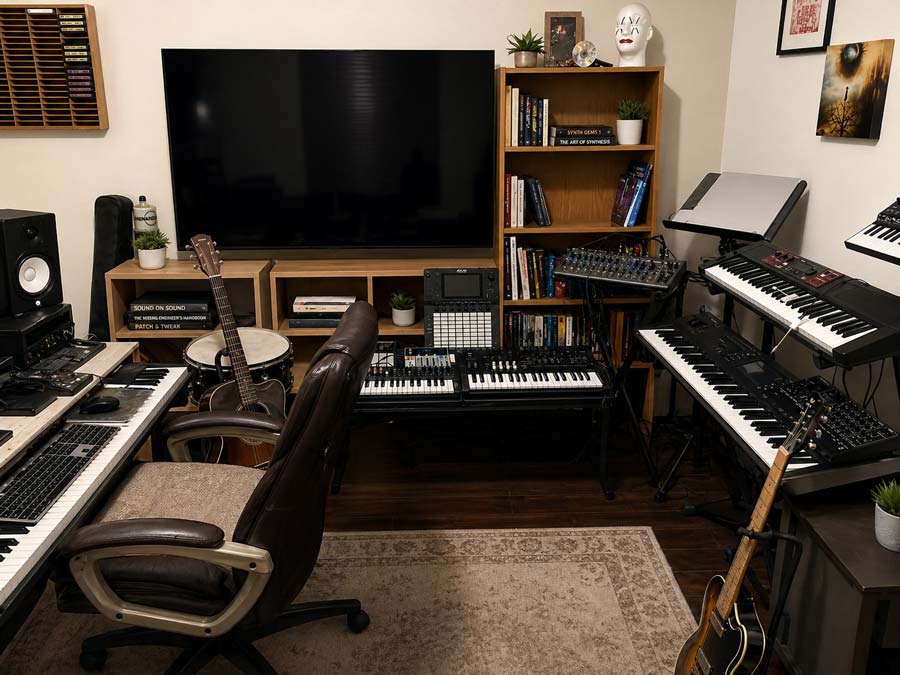
My Home Recording Studio In 2026
Here's a rundown of a few of my favorite things.
Synths
Arturia Minifreak
The Arturia Minifreak is one of those instruments that feels like it was made for how I work right now. I’ve always gravitated toward Arturia—I use the V Collection constantly, and my main controller is theirs—so the Minifreak fits naturally into my setup. What keeps pulling me back to it is the modulation matrix. It’s not just about dialing in a sound, it’s about letting the sound evolve on its own terms. I’ll start with something simple, route a few unexpected modulations, and suddenly it’s shifting, breathing, becoming something I wouldn’t have programmed intentionally. That’s exactly what I’m after these days. I’m not building full arrangements at the keyboard—I’m chasing moments. A measure, a texture, a loop that has its own character. The Minifreak almost always gives me something unique to grab, something I can lift and feed into Suno, where it becomes the seed for whatever comes next.
Korg Wavestate
The Korg Wavestate is where I go when I want motion without having to force it. It’s built around wave sequencing, so the sound is always evolving—rhythmically, tonally, texturally—before I even start pushing it further. I don’t approach it like a traditional synth. I’ll hold a chord or even a single note and just listen to what it does over time. There’s a kind of internal logic to it, but it still surprises me. That unpredictability is the hook. It gives me phrases and textures that already feel like part of a composition, which is perfect for how I work now. I’m looking for something I can capture—a loop or a moment that has movement baked into it—and the Wavestate delivers that almost every time. It pairs really naturally with the Minifreak too, the two of them creating these shifting layers that I can grab, reshape, and feed into Suno as the starting point for something larger.
Yamaha MODX
The Yamaha MODX is where I go when I want something that already feels complete. Compared to the more experimental gear in the room, it’s almost reassuring. The sounds are polished, wide, and immediately usable, whether I’m leaning into pianos, pads, or more complex layered textures. But it’s not just a preset machine—there’s depth there if I want it. I can shape things, stack elements, and build something that feels finished without losing too much time. That’s the key for me. Sometimes I don’t want to chase chaos or happy accidents—I want a sound that lands, something solid I can play against or pull from. The MODX gives me that foundation. It’s often the piece that balances everything else out, grounding the more unpredictable parts of the setup before I grab a phrase or progression and move it into Suno to take it somewhere else.
Arturia Microfreak
The Arturia Microfreak is the one I reach for when I want things to get a little strange, fast. It’s unpredictable in the best way—part synth, part experiment, part accident waiting to happen. The touch keyboard changes how I play, pushing me away from muscle memory and into something more reactive. I’m not really “performing” on it so much as poking at it, seeing what it does next. Between the different oscillator modes and the modulation possibilities, it can jump from something musical to something completely alien in a matter of seconds. That’s what I like about it. It doesn’t ask for precision—it rewards curiosity. A lot of times I’ll stumble into a sound or a short phrase that feels off in just the right way, something I wouldn’t have planned. That’s usually all I need. I grab that moment, loop it, and send it into Suno to see what it turns into.
Casio CT-S1000V
The Casio CT-S1000V is one of the stranger pieces in the room, and that’s saying something. It’s a vocal synth, but not in the traditional sense—you’re typing in phrases and letting the keyboard interpret them into something that almost resembles a human voice. Almost. It lives in that uncanny space where it’s expressive but never fully natural, which is exactly why I keep coming back to it. When it came out, Casio pushed it hard through YouTube influencers, like they knew they had something—but it never really stuck. It came and went pretty fast. Still, I can’t shake the feeling that there’s something buried in it, something in the software that hasn’t really been pulled out yet. I don’t treat it like a finished instrument. I treat it like something to dig into. Sometimes it gives me a usable phrase, sometimes it gives me something completely off, but even that has value. When it lands, it cuts through everything else with this synthetic humanity that’s hard to ignore. I’ll grab that moment and move it into Suno, where that voice—half real, half not—starts to become something else entirely.
Casio SK-1
I can’t leave out the Casio SK-1. It’s probably the oldest synth I still have—especially after losing a few pieces years back—and somehow it’s still hanging on. I haven’t used it constantly, but when it shows up, it matters. It goes all the way back to at least 1990 for me, on a track called “A Little Danger,” and every time I turn it on, it feels like it’s carrying that history with it. It still kind of works, which is part of the charm. The sampling is rough, the fidelity is low, and everything about it is limited—but that’s exactly why it cuts through. There’s no pretending with it. It’s immediate and a little broken in the best way. I used it again for an Electronic Cottage compilation Hal McGee put together, where everyone was working with “toy” synths, and it fit right in. The SK-1 isn’t about precision or polish. It’s about grabbing something raw and letting it be what it is. And somehow, after all this time, it still finds its way into the mix.
Samplers & Grooveboxes
Teenage Engineering OP-1 Field
The OP-1 Field is less of an instrument and more of a sketchbook—at least at first. It’s easy to pick up and just happenstance your way into something. A melody shows up, a rhythm falls into place, and before you know it, you’ve got the start of an idea without really trying. That’s what makes it so useful. It lowers the barrier to entry in a way most gear doesn’t. But once something clicks—once there’s a solid idea there—you do have to start thinking it through. The OP-1 doesn’t really let you ignore structure if you want to finish something on it. That’s usually the point where I step away from it. I’ll grab what I’ve got—a loop, a rough arrangement, a feeling—and move it into Logic Pro or into Suno, where I can shape it into something more complete. The OP-1 is the spark, not the whole fire.
Native Instruments Maschine
The Native Instruments Maschine feels like it should be more of a go-to for me than it actually is. It’s built around groovebox thinking—patterns, beats, structure—and I don’t really work that way most of the time. I’m not sitting down to build traditional beats or sequences from the ground up. Still, it earns its place. For me, it’s less about being a groovebox and more about being an interface into the Native Instruments world, especially Kontakt. It gives me quick access to a huge range of sounds, instruments, and textures without having to break the flow and dive into the computer. I can pull something up, tap it out, reshape it a bit, and grab what I need. It’s not the center of how I build things, but it’s a reliable entry point—a way to bring in more structured or recognizable elements when everything else starts drifting too far into abstraction. When I do use it, it tends to be in small, purposeful ways, feeding just enough into the system before I move on.
Roland SP-404 MKII
The Roland SP-404 MKII is where things start to break down in a good way. It’s less about playing and more about capturing, bending, and reshaping whatever I feed into it. I’ll pull in something from the Minifreak or Wavestate—or even something rough from the OP-1—and the 404 turns it into something else entirely. The effects are a big part of that. They’re immediate and a little unpredictable, the kind of tools you can push too far and end up somewhere better because of it. I don’t approach it like a traditional sampler with careful planning. It’s more instinct than intention. Grab a sound, mess with it, resample it, repeat. Each pass pulls it further away from where it started. That’s usually where it gets interesting. The SP-404 is one of those pieces that doesn’t ask for precision—it rewards experimentation. By the time I’m done with it, the original idea is still in there somewhere, but it’s been twisted just enough to feel new, something I can pull into the larger system or send into Suno as a completely different kind of starting point.
AKAI Force
The AKAI Force sits right in the middle of everything, even if I don’t always use it that way. It’s probably the most capable piece in the room when it comes to being a standalone production environment—clips, arrangement, sampling, effects, all of it in one place. But I don’t really approach it as a full workstation. Like the Maschine, it leans into that groovebox mindset—building tracks from patterns and structure—and that’s not usually how I start. What I do use it for is capturing and organizing ideas when things begin to take shape. It’s a bridge between the loose, exploratory side of the setup and something more intentional. I can pull in loops, layer parts, stretch things out a bit, and see how they start to live together. It gives me just enough structure without locking me into a way of working I don’t fully commit to. Sometimes it becomes a holding space, sometimes a sketchpad with more muscle behind it. Either way, it helps me move from fragments toward something that feels like it could become a piece—before I take it further into Logic Pro or hand it off to Suno to push it somewhere else.
AKAI Sample
The AKAI Sample is the new kid in the room—just over a month in—and it’s already found its way into the regular rotation. There’s something about how immediate it is that fits the way I’m working right now. It doesn’t get in the way. I can load something up, start chopping, start shaping, and be into an idea almost instantly. It feels a little more direct than some of the other boxes—less about menus, more about just doing. That’s probably why I’ve been using it so much. It gives me quick access to raw material, and from there I can push it in whatever direction I need. Sometimes it stays simple, sometimes it turns into something more layered, but either way it gets me moving fast. And that’s usually all I’m looking for—a way in.
Teenage Engineering EP-133 K.O. II
The Teenage Engineering EP-133 K.O. II feels like a stripped-down extension of the whole sampler mindset, but with its own personality. It’s immediate in a way that’s hard to ignore—no deep diving, no overthinking, just load something up and start hitting pads. Compared to the larger boxes, it almost feels disposable in the best sense. I don’t worry about building something perfect on it. I’m just reacting—chopping, triggering, letting things fall where they fall. And it’s probably the most fun piece in the room. The punch-in effects turn it into a performance instrument more than anything else—something you play in real time, pushing and pulling the sound as it’s happening. Because it lives a little off to the side of the main setup, it shifts how I approach it too. I’m not in the middle of everything when I use it, so the ideas tend to be more focused, a little more intentional. It’s a quick capture device, a place to test a rhythm or a texture without committing to anything bigger. A lot of what comes out of it ends up being small but useful—fragments that can either stand on their own or get pulled into the larger system, and eventually into Suno, where they take on a different shape entirely.
A World of VST's
Native Instruments Komplete Ultimate
Native Instruments Komplete Ultimate is less of a single tool and more like a deep reservoir I can pull from when I need something specific. It covers a lot of ground—Kontakt libraries, synths, drums, effects—and I don’t approach it as something to master front to back. It’s more about knowing it’s there. When I need a particular texture, an instrument that feels grounded, or something that sits in a more traditional musical space, Komplete is usually where I go. Kontakt, especially, is the center of that. It opens up a huge range of sampled instruments that feel finished right out of the gate, which is useful when everything else in the room starts drifting into abstraction. At the same time, it’s easy to get lost in it. There’s so much there that it can slow things down if I’m not careful. So I tend to treat it the same way I treat the rest of the setup—grab what I need, don’t overthink it, and move on. It’s not the spark, but it’s a powerful support system once something starts to take shape.
Arturia V Collection
The Arturia V Collection is probably the most quietly essential part of the whole setup. It doesn’t sit on a shelf, it doesn’t take up space in the room, but it’s everywhere in the work. I’ve always been drawn to what Arturia does—there’s a consistency to the way their instruments feel, even across very different synths—and the V Collection gives me access to a huge range of those voices without breaking the flow. I’m not approaching it like a historian, chasing faithful recreations of classic gear. I’m using it as a palette. If I need something warm, something unstable, something familiar but slightly off, it’s usually in there somewhere. And because it all ties back into the same ecosystem as the Minifreak and my controller, it feels connected to the rest of the room rather than separate from it. It’s easy to overlook because it lives inside the computer, but it’s constantly feeding ideas into everything else—quietly doing a lot of the heavy lifting once something starts to take shape.
Decent Sampler
Decent Sampler sits in a different space than something like Kontakt, even though it’s aiming at a similar idea. It’s lighter, more open, and a little more scrappy in a way that I appreciate. It’s free, which almost undersells it, because it’s actually a pretty capable sampler with its own growing ecosystem of libraries. (decent|SAMPLES) I don’t think of it as a replacement for anything—I think of it more like an alternative path. There’s a community around it that feels closer to the old Tapegerm mindset: people sharing instruments, textures, odd recordings, things that aren’t overly polished. That’s where it gets interesting to me. It’s not about pristine orchestral libraries. It’s about character. It feels like something that’s still evolving, both in the software and in the way people are using it. There’s a looseness to it that fits how I work. I can load something up quickly, explore it without a lot of friction, and grab a sound or phrase that feels a little different from the more established libraries. It’s another way in—less formal, a little more experimental, and still finding its identity, which is probably why it’s worth paying attention to.
u-he
u-he sits in a slightly different space from the bigger collections. It’s not about volume—it’s about depth. There aren’t dozens of instruments, but the ones that are there feel carefully built and worth spending time with. I tend to come back to things like Diva and Repro when I want something that feels alive in a more analog sense—subtle movement, imperfections, tones that don’t sit perfectly still. There’s a weight to them that’s different from a lot of software synths. They ask a little more of you. You don’t just flip through presets and move on—you shape them, sit with them, let them settle into the track. That can slow things down if I’m not careful, but it can also lead to something more intentional. When I need a sound that feels grounded but still has character, u-he is usually where I land. It’s less about quick ideas and more about finding something that holds up once everything else starts building around it.
Spitfire LABS
Spitfire LABS feels like that weird uncle who’s really, really into sampling. The one who pulls you aside and says, “You’ve got to hear this,” and then spends five hours walking you through every tiny detail of how this one very specific instrument was captured. That’s the vibe. Each LABS instrument is its own little world—focused, a bit obsessive, and built around a single idea taken just far enough to be interesting. Some of them are beautiful, some are odd, some feel almost too specific to use, but that’s part of the appeal. I’m not loading LABS to cover all bases. I’m loading it to see what this one thing does. And when it clicks, it really clicks. There’s a kind of personality baked into those sounds, like someone cared a little too much about getting it just right. It doesn’t always fit, but when it does, it adds something that feels deliberate and a little eccentric—something I probably wouldn’t have found anywhere else.
Spitfire LABS (and where it’s going)
LABS used to feel like its own little world. You’d load it up, pick one instrument, and spend time with it—something oddly specific, carefully sampled, and built around a single idea. It didn’t try to be everything. That was the appeal. It felt personal, almost handmade. It still does, but…
Now it’s shifting. LABS is being absorbed into Splice Instrument, which changes the context entirely. Instead of a collection of standalone, curated instruments, it becomes part of a much larger ecosystem—one built around access, scale, and constant updates. There’s more content, more variety, more of everything. That’s not necessarily a bad thing. It just moves it away from what it originally felt like.
What made LABS interesting was its limitations. You weren’t scrolling through thousands of options. You were sitting with one thing and figuring out what it could do. Inside Splice, it risks becoming just another category—another set of sounds to browse past on the way to something else. At the same time, there’s potential there. If that same attention to detail survives inside a larger system, it could open up new directions.
It’s one of those transitions that says more about where music tools are heading than about LABS itself. Everything is becoming a platform. LABS just happens to be one of the more interesting things to watch as it makes that move.
Vital (Matt Tytel)
Vital is one of those synths that feels almost too powerful for how accessible it is. Even at the $5/month tier I’m on, it gives me more than enough to work with. The interface is clean, the visual feedback is immediate, and everything invites you to dig in and actually understand what’s happening to the sound. I don’t approach it like a preset browser—I treat it more like a playground for building something from the ground up. Wavetables, modulation, movement—it’s all right there, and it responds in a way that feels modern without losing that sense of exploration. There’s a clarity to it that makes experimentation feel less like guesswork. When I want something that sits somewhere between the precision of software and the unpredictability of hardware, Vital is usually where I land. It’s quick to get into, deep enough to stay interesting, and it almost always gives me something I can pull into the larger system and push further—whether that ends up in Logic or gets fed into Suno as the starting point for something else.
Lunacy Audio CUBE
Lunacy Audio CUBE feels like a sampler that doesn’t want to sit still. It’s built around this idea of navigating sound in three dimensions—blending between sources, moving through textures, morphing from one state to another—and that fits right in with how I tend to work. I’m not usually looking for a fixed sound. I’m looking for something that changes as I hold it, something that reveals itself over time. CUBE makes that part easy. I can start with a simple pad or tone and then just move through it, letting the sound shift under my hands. It’s less about programming and more about exploring. There’s a tactile quality to it, even though it lives entirely in the computer. It feels like I’m steering rather than building. That makes it a strong companion to the hardware in the room, especially the Minifreak and Wavestate, where movement is already part of the sound. CUBE picks that idea up and pushes it further in a different direction. A lot of what comes out of it ends up being these evolving textures—perfect for grabbing a moment, looping it, and feeding it into Suno to see where it goes next.
LennarDigital Sylenth1
Sylenth1 is one of those synths that’s been around long enough to feel almost invisible, but it still shows up when I need it. It’s straightforward in a way a lot of newer synths aren’t—no extra layers, no conceptual framework, just oscillators, filters, envelopes, and a sound that lands quickly. I don’t go to it for experimentation or surprise. I go to it when I want something to work right away. It has a certain clarity and presence that cuts through without much effort, especially for leads, basses, and simple harmonic parts. In a setup where a lot of things are constantly shifting and evolving, Sylenth1 is a bit of a counterweight. It holds its shape. It does what it’s supposed to do without asking for too much attention. And sometimes that’s exactly what I need—something reliable I can drop into the mix, grab a phrase from, and move forward without getting pulled too far into the process.
KV331 Audio SynthMaster (One & 2.9)
SynthMaster One and SynthMaster 2.9 feel like two sides of the same idea, but they don’t really overlap in how I use them. SynthMaster One is the one I reach for. It’s immediate, focused, and easy to get into. It’s built around wavetables, so there’s movement there, but it doesn’t slow me down. I can pull up a sound, nudge it a little, shape it just enough, and move on. It fits the way I’m working now—quick entry, find a moment, grab it, and feed it into the system.
SynthMaster 2.9 is something else entirely. It’s deeper, more layered, more of a place to build something from the ground up. There’s a lot more going on under the surface—different synthesis types, more routing, more control—and because of that, it asks more of you. I don’t drop into it casually. When I open it, it’s usually because I’m willing to spend some time shaping a sound, letting it develop, maybe even letting it become the center of something rather than just a fragment.
They share a name, but they don’t feel like versions of the same instrument. One is about speed and access. The other is about depth and intention. Most of the time, I’m moving too quickly to stay inside 2.9 for long, so SynthMaster One ends up doing more of the work. But it’s good to know the deeper one is there when I want to go further, when I want to build something that doesn’t just pass through but actually sticks around.
Klevgrand (Tomofon & Speldosa)
Klevgrand’s stuff sits a little off to the side of everything else, but in a way that makes it stand out. Tomofon and Speldosa don’t feel like traditional instruments so much as ideas turned into instruments. Tomofon is built around sampled waveforms—tiny slices of sound mapped across the keyboard—so it ends up feeling familiar and completely strange at the same time. You’re playing something that resembles a synth, but it behaves more like a collage of audio fragments. It’s easy to land somewhere unexpected without really trying. Speldosa is even more specific. It’s built around the sound of a music box, but stretched, detuned, and reshaped into something that can feel delicate one moment and slightly unsettling the next. Both of them have a kind of intentional limitation that I like. They’re not trying to cover everything. They’re trying to do one thing well, but in a way that opens it up just enough to be explored. I don’t use them constantly, but when I do, it’s usually because I want something with a very particular character—something that doesn’t quite behave like anything else in the room. They tend to give me those small, distinct moments that stand apart, the kind of fragments that can shift the direction of a piece once they’re pulled into the larger system.
Extent of the Jam – Digits
Digits is one of those pieces that feels like it slipped through from another timeline—like someone picked up the Casio CZ thread and just kept going without asking permission. It sits comfortably alongside the SK-1 and the CT-S1000V in spirit, even though it lives entirely inside the machine. There’s that same slightly brittle, glass-edged digital tone, the kind that doesn’t try to hide what it is. I’ve always liked that sound. It reminds me of early home recording, of figuring things out as you go, of working with what you have and letting the character show through. Digits taps into that, but it doesn’t stay there. It opens up just enough to make you curious. You think you understand it, then it shifts a little. That’s where it gets interesting. It’s not something I lean on constantly, but when I bring it in, it adds a very specific color—something a little nostalgic, a little forward-looking, and just unstable enough to feel alive. It fits right into the flow of the room, another voice in the ongoing conversation.
Glitchmachines (Fracture & Hysteresis)
Fracture and Hysteresis sit in that zone where sound starts to come apart. They’re not instruments in the traditional sense—they’re processes, ways of breaking things down and reassembling them into something less predictable. I don’t load them up looking for polish. I load them up when I want to push something past the point where it was supposed to go. A clean loop goes in, and what comes out is fractured, stretched, smeared across time. Sometimes it’s subtle, just enough to rough up the edges. Other times it’s complete disintegration.
There’s a kind of controlled chaos to both of them. You can guide it, but you don’t fully control it, and that’s the appeal. They introduce movement and instability in a way that feels alive, especially when everything else starts getting too clean or too defined. I’ll run something through Fracture or Hysteresis, grab a moment from the result, and suddenly it’s not the same idea anymore. It’s been pushed somewhere else. That’s usually all I need—a shift, a break in the pattern—before it goes back into the system or into Suno to keep evolving.
Guitar, Bass, Drums
And then there are the "real" instruments. (kidding)
A Burns Steer electric guitar and a Yamaha acoustic are always within reach—two completely different voices, both useful for breaking out of the grid. The snare from a Pacific drum set sits nearby too, ready for when I want something physical, immediate, and imperfect to cut through everything else.
That's It
The whole room is built around movement—turning from one station to another, shifting from keys to pads to strings to drum hits. Nothing is isolated. Everything feeds everything else.
The shelves around me are part storage, part inspiration. Books, random gear, fragments of past projects, things I haven’t used in years but might again tomorrow. There’s no strict order to it, but I know where everything is. It’s a working space, not a showroom.
And then there are the small personal details—the mask, the art, the clutter that never fully goes away. That’s all part of it too. This isn’t a pristine studio. It’s lived in. It’s where ideas get tested, abandoned, revived, and sometimes finished.