
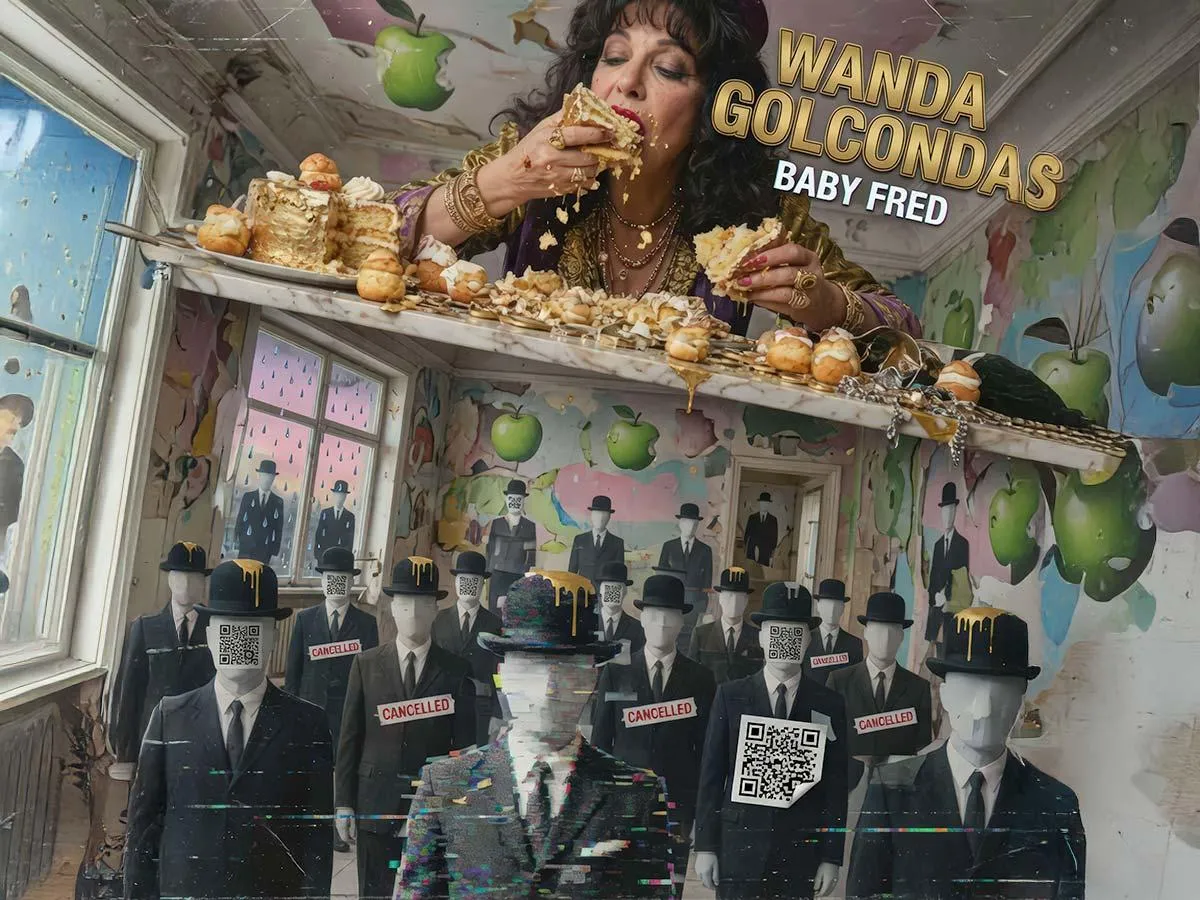
Wanda Golconda: Briyan Frederick and Joe Maki’s Surreal Portrait of Greed, Replication, and Golden Desire
Written by Briyan Frederick Baker and Joe Maki
℗ by Blind Mime Music, ASCAP & Jomah Kai Music, ASCAP | babyfredmusic.com
© Briyan Frederick Baker, Joseph Alan Maki. All rights reserved.
“Wanda Golconda” by Briyan Frederick and Joe Maki, also known as Baby Fred, begins with a title that feels like a found object from two different worlds. “Wanda” is intimate, human, maybe even comic. It sounds like a name pulled from ordinary life. “Golconda,” on the other hand, opens into art history, wealth, myth, and surrealism. It calls to mind René Magritte’s painting Golconda, with its repeated bowler-hatted men suspended in the air like a strange weather pattern. It also carries the older association of Golconda as a place of legendary riches. Put together, the title becomes a compact statement of the song’s central tension: a personal obsession wrapped in imagery of wealth, duplication, and falling men.
The lyric introduces Wanda as a figure of excess: “She’s dressed in opulence and decadance / She’s eating cake before the meals commence.” The image is funny, grotesque, and pointed. Cake before the meal suggests appetite ahead of need, consumption before ceremony, reward before work. Wanda does not merely enjoy luxury; she appears to live inside it as a natural atmosphere. She “hoards and absorbs and pays no consequence,” a line that gives her a quality larger than a person. She could be a woman, a muse, a system, a marketplace, an algorithm, or the seduction of having more than one needs.
That ambiguity gives the song its charge. Wanda is named like an individual, but she behaves like a force. She consumes without consequence. She is “blind to tolerance,” a phrase that suggests a refusal to consider limits, others, restraint, proportion, or mercy. The narrator sees all of this clearly, yet the song refuses to let him stand safely outside the critique. By the chorus, he is not rejecting Wanda. He is singing to her. He is dependent on her. He needs the very thing he has already described as decadent and destructive.
The second verse turns the lens toward the narrator, and the Magritte influence comes fully into view: “I’m just another man cut and pasted in / Bowler hat and suit, no apple core within.” The bowler hat places him in the visual world of Magritte’s anonymous men, but the “no apple core within” line twists the reference beautifully. In Magritte’s The Son of Man, the apple blocks the face. Here, there is no hidden organic center at all. The narrator is not a mystery waiting to be uncovered. He is a pasted figure, a copy, an image without a core.
The next line brings that surrealist vocabulary into the present: “Like a QR code, a cancel stamp, a mannequin.” It is a sharp sequence. A QR code can be scanned but cannot be read intuitively by the human eye. A cancel stamp marks something as processed, used, invalidated, or complete. A mannequin resembles a person but exists for display. Together, these images describe a modern self turned into code, judgment, and surface. The narrator is readable to systems, available to commerce, and estranged from himself.
“Unsmiling unaware of what goes on in him” may be the song’s quietest horror. The line suggests a man so absorbed into the pattern that even his inner life has become inaccessible. He is not simply sad. He is unaware of his own contents. The lyric presents this condition with eerie calm, allowing the absurd images to carry the emotional weight.
The chorus then arrives as a confession of devotion: “But my Wanda Golconda / She’s all I really need.” The word “but” matters. After all the images of excess, hollowness, and replication, the narrator turns toward Wanda as the answer. “Fulfills my every need” sounds like the language of romance, but the line that follows exposes the bargain: “I don’t need much, just her midas touch / Just to feed my greed.” This is love as appetite. Wanda’s golden power satisfies the narrator because it gives him access to the very excess he has been circling.
The Midas reference is crucial. In the myth, the golden touch is both gift and curse. It turns everything into value and, in doing so, destroys ordinary life. Food, touch, and affection become beautiful and unusable. In “Wanda Golconda,” that myth becomes a modern emotional condition. Everything can be transformed into signal, status, commodity, surface, or possession. The narrator understands the danger, but understanding does not free him from desire. The chorus works because it sounds like surrender. He knows what Wanda is, and he wants her anyway.
The recording supports this sense of seduction inside repetition. The supplied master runs just over four minutes and carries an embedded tempo marker of 120 BPM, giving the piece a steady, almost grid-like pulse. That evenness suits the lyric’s world of copied men, digital static, boxed matrices, and soothing rhythms. The song’s momentum feels less like escape than continuation. It moves forward with the calm insistence of a system that has already absorbed complaint.
In the third verse, the lyric steps fully into digital alienation: “My life’s a videodrome of static digital noise / Oddly uniform and oddly so precise.” The line invokes media overload, signal decay, and the uncanny feeling of living inside screens. Yet the noise is not wild. It is “uniform” and “precise.” This is a world where chaos has been organized into a grid. “Like a matrix boxed and squared multiplied and diced” continues the image of modern life as modular and repeatable: apartments, pixels, spreadsheets, social feeds, production templates, identity blocks.
Then comes the wonderfully deadpan line: “Glitching out of sync but everything is nice.” That “nice” is doing brutal work. It is the language of acceptance, customer service, social smoothing, and emotional avoidance. Something is visibly wrong, but the surface remains pleasant enough. The world glitches, and the narrator shrugs because the system still functions. This is one of the song’s strongest observations: disorder no longer needs to look dramatic. It can be clean, designed, pleasant, and oddly precise.
The bridge pushes the song into denser surrealism: “Suit and tie, no mouth, no eyes / Apartment complexities / Extrapolate the mundane gestalt / That puckers your extremeties.” The suited figure now lacks speech and sight. The apartment image suggests lives stacked and compartmentalized, each person boxed into a private unit within a larger design. “Mundane gestalt” is both comic and revealing. The song takes ordinary modern repetition and treats it as a psychological architecture. The phrase “puckers your extremeties” gives the abstraction a bodily reaction, as though the weirdness of everyday life has become physically uncomfortable.
The final verse makes the song’s self-awareness explicit: “Day after day this rhythm soothes my brain / I’m duplicated, replicated but I can’t complain.” The rhythm may be musical, social, economic, technological, or all of these at once. Repetition becomes sedation. Duplication becomes normal. The narrator recognizes his condition, but recognition becomes part of the loop rather than a way out of it.
“This brave new world is something no one can quite name” widens the song’s frame. It gestures toward a present defined by forces we feel daily but struggle to describe cleanly: algorithmic desire, consumer identity, digital performance, automated sameness, artificial abundance, and the comfort of patterned life. The closing image, “I am just another man falling down like rain,” completes the Golconda reference with a melancholy turn. In Magritte’s painting, the men seem suspended between rising and falling. Here, the narrator names the direction. He is falling, and he is one of many.
“Wanda Golconda” succeeds because Frederick and Maki allow the song to remain playful while its implications darken. The lyric is full of wit: cake before dinner, QR codes, bowler hats, Midas touches, boxed matrices, mundane gestalts. But the wit never cancels the unease. Beneath the surreal imagery is a recognizable emotional condition: wanting what empties you, loving what consumes you, and finding comfort in the rhythm of your own replication.
Wanda may be a woman, but she is also wealth, appetite, spectacle, technology, and the golden promise that everything can be transformed into more. The narrator’s tragedy is that he sees the pattern clearly and still sings the chorus with devotion. That is what makes the song linger. It turns a Magritte-like image of falling men into a modern pop confession: we are duplicated, we are scanned, we are stamped, we are soothed by the rhythm, and somewhere in the middle of it all, we keep reaching for Wanda’s golden hand.