
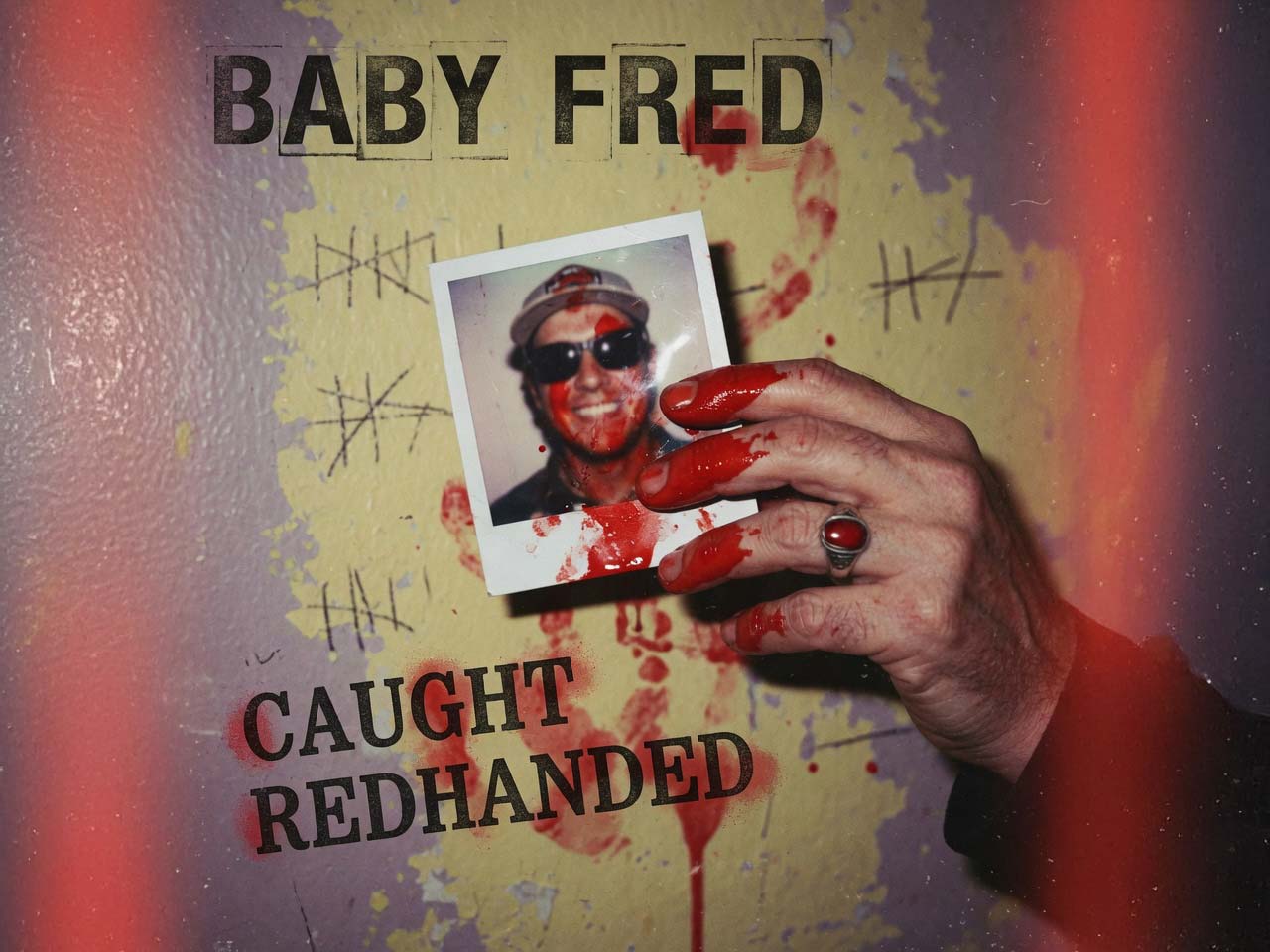
Caught Redhanded
Written by Briyan Frederick and Joe Maki | babyfredmusic.com
℗ by Blind Mime Music, ASCAP & Jomah Kai Music, ASCAP
© Briyan Frederick Baker, Joseph Alan Maki. All rights reserved.
Joe Maki: original instrumental track
Briyan Frederick: lyric, voice model, arrangement and mix with sunoai
I blustered in one day all full of fire and haste
Headstrong and confident
Another young foolwhose youth was left to waste
Stupid and diffidentGetting into trouble despite any good intention
Cocksure inexperience
Taking without asking, possessed of blind pretension
I was deliriousBut that was then and this is now
I somehow thought I'd gotten past it
I even thought I'd won or lasted
But no, no, no, no
No, no, no -- I've been caughtRedhanded!
No way out redhanded
Without a doubt redhanded
Redhanded woe is me
Redhanded - nowhere to flee
(I'VE BEEN CAUGHT) redhandedNow I can't get past the guard, I'm marked and branded
Can't find a substitute
It's all a blur how I ended up a thief that time demanded
Time's grim absolutesNo matter then 'cos this is now
I somehow thought I'd gotten past it
I even thought I'd won or lasted
But no, no, no, no
No, no, no -- I've been caughtRedhanded!
No way out redhanded
Without a doubt redhanded
Redhanded woe is me
Redhandednowhere to flee
(I'VE BEEN CAUGHT) redhandedAll alongthis song was playing
All us donkeys kicks and braying
And that's all I'm really saying
When I'm saying
All I have the strength to say…Now I scuffle with the old men lost and muddled in their dreams
What a life it's now become
You take your time when you are coming and going in between
Nowhere to to go to unbegunSo what happens then is this is now
I somehow thought I'd gotten past it
I even thought I'd won or lasted
But no, no, no, no
No, no, no -- I've been caughtRedhanded!
No way out redhanded
Without a doubt redhanded
Redhanded woe is me
Redhandednowhere to flee
(I'VE BEEN CAUGHT) redhanded
I’ve reached an age where the past doesn’t stay politely behind me. It turns up in odd places, not always dramatically, not always with thunder and ghosts. Sometimes it’s in a conversation that takes a turn I didn’t expect. Sometimes it’s in the face of another man about my age, someone I barely know, and I can see he’s carrying his own weather. Sometimes it’s in the way I move through a day and realize the body has its own opinions now, the mind has its own fog, and time has become less interested in negotiation.
Nobody says much about it directly. We joke. We deflect. We talk about practical things. We talk about appointments and errands and what hurts and what needs fixing around the house. We talk around the thing, which is probably how most of us survive it. But there is a kind of evidence that gathers over time, and whether we speak of it or not, it starts to pile up around us.
“Redhanded” came out of that feeling. The word itself is loud and theatrical. It points to a crime. It points to somebody caught in the act, hand marked, no way out, no explanation clever enough to undo the obvious. There’s a courtroom melodrama in it. There’s a cartoon thief with his pockets full. There’s somebody trying to sneak away through the side door while everyone in the room turns and stares.
But for me, the crime in the song isn’t some literal offense. It’s the crime of aging. It’s being caught with circumstance; not so much without a plan, but with maybe too many best laid. It’s time arriving to collect what it is owed, whether or not you understood the terms when you started. It’s not orderly. Life rarely is. But it resolves one way or another. That’s the part we sometimes avoid looking at. A life does not have to make sense in order to move toward its conclusions.
The song starts with a younger version of the narrator, or maybe a younger version of me, or maybe just the younger version of almost everybody. “I blustered in one day all full of fire and haste.” That line knows the foolishness of youth, but it also remembers the energy of it. There is something almost admirable in that kind of unearned confidence, even when it is ridiculous. You come into the world headstrong, convinced that momentum is the same as direction. You mistake volume for meaning. You mistake desire for destiny. You think the future will keep making room for you because, so far, it has.
Then comes the other side of it: “Another young fool whose youth was left to waste / Stupid and diffident.” I like the contradiction there. Headstrong and diffident at the same time. Full of fire and unsure. Cocksure and inwardly doubtful. That feels true to me. A person can swagger because he doesn’t know what he’s doing. A person can be loud because he’s afraid. A person can be reckless not because he has too much belief in himself, but because he doesn’t yet understand the cost of anything.
The narrator is not innocent. I think that matters. It would be too easy to make the song about life doing things to us. Life does plenty. Circumstance has its way. Bodies betray us. Money shifts. Work changes. Family arrangements alter. People leave. People need us. People disappoint us, and we disappoint them. Health becomes less theoretical. Time removes options without asking if we’re ready. All of that is true, and preparation only gets a person so far. You can prepare and still be overtaken. You can make plans and still find yourself standing in some strange hallway wondering how exactly you got there.
But “redhanded” doesn’t let the narrator off the hook. The word itself implies that he had a hand in the undoing. He may have been caught by time, but he is not blameless. Most of us aren’t. We make choices. We follow impulses. We take without asking. We assume too much. We waste what later turns out to have been precious. We leave fingerprints on the wreckage and then act surprised when someone points them out.
That is the tension I wanted in the lyric, whether I knew it fully at the time or not. I don’t look for surety when I write. I’m not usually interested in pinning a song to one fixed explanation. A song ought to carry more than that if it can. But looking at “Redhanded,” I can see that it is standing in that uneasy place between circumstance and responsibility. Life happens regardless of preparation, but we are usually not entirely innocent in how it happens to us.
The chorus is almost comically direct. “Redhanded! / No way out redhanded / Without a doubt redhanded.” It’s not subtle. It doesn’t want to be subtle. It has a kind of shouted accusation in it, and maybe even a little vaudeville. The narrator is caught, and he knows he is caught. There is no elegant defense left. He can’t talk his way around it. He can’t reframe it into something noble. He can’t bring in a substitute. There he is, marked and branded, with nowhere to flee.
And yet, underneath the comedy, I think it is probably a tragedy. Not in a grand theatrical sense, with everybody dead on the stage at the end, but in the quieter and more common sense that a large percentage of us are caught redhanded eventually. We reach some point where we can no longer maintain the old story about ourselves. The evidence has accumulated. The younger self is still connected to the older one. The consequences are not always dramatic, but they are real. The doors that once seemed open are not all open anymore.
That is what I hear in “I somehow thought I’d gotten past it / I even thought I’d won or lasted.” That’s a human thing to say. It’s the voice of somebody who believed time itself had proven something. I made it this far. I endured. I survived. I outgrew the stupidity. I’m not that person now. That was then and this is now.
But the song keeps answering back: no, no, no, no.
That was then and this is now sounds like a defense. We all use some version of it. We want distance from who we were. We want to believe the old mistakes belong to someone else because the body has changed, the face has changed, the circumstances have changed. We want to believe we have matured beyond the original crime. But the chorus collapses the distance. It says the younger fool is still in the room. Maybe quieter now. Maybe disguised. Maybe sitting in the corner with gray hair and better excuses. But still present.
Time is strange that way. It moves forward, but it doesn’t simply erase. It layers. We carry versions of ourselves around, and sometimes they wake up at inconvenient moments. The foolish young man, the arrogant young man, the frightened young man, the one who took without asking, the one who thought he was entitled to more than he understood — he doesn’t vanish just because decades pass. He becomes memory. He becomes habit. He becomes a reflex. He becomes a bruise you forgot about until something presses on it.
The line “Time’s grim absolutes” feels like one of the hinges of the song. Time doesn’t only pass. It removes options. That may be one of the harder truths of getting older. When you are young, the future feels like a vast field of possible selves. Even if you are miserable, confused, broke, foolish, or lost, there is still the sense that another version of you might be waiting just ahead. You can start over. You can reinvent. You can become disciplined. You can become generous. You can become brilliant. You can become the one who got away from all the traps.
At some point, though, you begin to understand that not every self can still be chosen. Not every road can still be taken. Not every relationship can be restored. Not every wound can be explained away. Not every talent can be developed. Not every debt can be repaid in the coin you wish you still had. That doesn’t mean life is over, but it does mean the fantasy of infinite substitution begins to fail. You can’t always find a substitute. You can’t step aside and send in some better-prepared version of yourself.
That is grim, but it is not only grim. There is also a kind of clarity in it. Maybe that is where the weary humor comes in. The narrator is not laughing because it is all fine. He is laughing because the situation is absurd. To be human is to scuffle. We scuffle with the past. We scuffle with the present. We scuffle with the body, the mind, family, friends, memory, responsibility, and whatever weird unfinished business keeps following us home. We scuffle because there is no perfectly orderly way to live a life.
I like the word “scuffle” because it is not heroic. It is not battle, exactly. It is not a noble war. It’s messier and smaller than that. It has elbows in it. It has shuffling feet. It has confusion. It has old men lost and muddled in their dreams. It has people trying to keep their balance while carrying too many invisible packages. It has comedy in it because we are ridiculous creatures, but it also has sorrow because the stakes are real.
The line “All us donkeys kicks and braying” points to Pinocchio for me. I didn’t spell it out in the lyric, but that is where the image comes from. Pinocchio has that strange moral nightmare built into it, where foolish boys are lured away, indulge themselves, and are transformed into donkeys. It’s funny and horrifying at the same time. The braying is comic, but the transformation is punishment. They were warned, or should have known, or maybe could not have known enough. They were foolish, but they were also manipulated. They had appetites. They wanted escape. They became visible in their foolishness.
That reference opens up more than one door. There is the obvious idea of being punished for bad choices, of being caught in the consequences of appetite and stupidity. But Pinocchio also carries the longing to become real. That’s the deeper ache inside the story. It’s not only about misbehavior. It’s about becoming a person. It’s about failing and trying and lying and wanting and being shaped by the world’s rough hands. In “Redhanded,” the donkey image gives me both things. We are foolish and transformed, yes, but we are also trying to become real, and maybe part of becoming real is seeing the evidence at last.
I don’t want to over-explain that. I’d rather let the image remain half-lit. The song doesn’t need to walk the listener through every implication. It’s enough for the donkeys to kick and bray inside the lyric. It’s enough for that absurd sound to arrive in the middle of a song about being caught by time. Sometimes a reference works because it is not fully domesticated. It stands there, slightly unruly, carrying punishment, comedy, shame, and longing all at once.
The final verse brings the song into a shared room. “Now I scuffle with the old men lost and muddled in their dreams.” Those are literal people to me, many like me, scuffling with the past and the present. There is something tender and brutal in that image. The old men are not wise elders on a mountaintop. They are not dispensing polished lessons. They are muddled. They are still dreaming. They are still caught in the old weather. They are still trying to sort out what happened, what they did, what was done to them, and what can still be done now.
That feels honest to me. Aging is not a clean arrival into wisdom. Maybe wisdom comes in pieces, but so does confusion. You don’t simply cross a bridge and become serene. You still have your absurdities. You still have your appetites. You still have your defenses. You still have your old stories and your old evasions. Meanwhile, the practical facts of the present keep pressing in. Health changes. The body becomes less obedient. The mind may become more reflective, but also more crowded. Relationships with family and friends shift. Roles reverse. People who once held you up may need holding. People you thought would always be there may drift, decline, or disappear. The map keeps redrawing itself.
I didn’t want to name all of that too plainly in the lyric. Implications abound, and sometimes implication is more truthful than explanation. If I had written a song that said, “This is about aging and health and changing relationships,” it would probably lose the thing that makes it alive. The guard, the branding, the thief, the donkeys, the old men, the grim absolutes of time — these images carry the weight without turning the song into a lecture.
That matters to me because I don’t think songs should always behave like essays. Even when I’m writing this now, trying to explain the lyric, I don’t want to close it down too much. A lyric can know things the writer doesn’t fully know yet. It can make connections before the conscious mind has filed the paperwork. In this case, “Redhanded” seems to know that the comedy and tragedy are inseparable. It knows that guilt and circumstance are tangled. It knows that age is not only something that happens to us, but something that reveals us.
There’s a line in the lyric: “Nowhere to go to unbegun.” That awkwardness feels right to me. It is not smooth, and I don’t think it should be. It points toward the impossibility of starting from some pure beginning. We want clean beginnings. We want a fresh page. We want to go back before the evidence, before the mistake, before the scuffle, before the body became a calendar, before family history became a house full of locked rooms. But there is no unbegun place to go. There is only here, with whatever has gathered.
And still, here is not nothing. That is important too. The song is not a surrender note. It argues even as it accepts. That’s why the repeated “No, no, no, no” matters. The narrator is caught, but he is still pushing back. He accepts that time removes options, but he is not entirely done objecting. To be human means we scuffle, and part of the scuffle is that we rarely accept our condition in one clean motion. We accept it, then resist it, then laugh at it, then deny it, then confess it, then make a song out of it.
Maybe that is why the chorus keeps returning with such blunt force. “Redhanded” is an accusation, but it becomes a kind of chant. It is almost communal by the end. At first, the narrator seems to be pointing at himself, or being pointed at. But eventually, the circle widens. All us donkeys. All of us with our kicks and braying. All of us trying to explain how we ended up here. All of us caught in some mixture of what happened to us and what we helped make happen.
That is the raw nerve of the song for me. I don’t think the narrator wants pity. I don’t think he is asking to be excused. I also don’t think he is delivering some moral instruction from a superior place. He is in it. He is marked. He is laughing because the scene is absurd, and he is grieving because the evidence is real. He thought he had gotten past it. He thought he had won or lasted. Then time, circumstance, memory, and responsibility all turned toward him at once and said, not so fast.
Writing lyrics often feels like setting a trap for myself. I start with a phrase, an image, a rhythm, a joke, and then the song catches something I wasn’t necessarily planning to confess. “Redhanded” is one of those. The title sounds like a punchline, but the song keeps dragging it into deeper water. It catches the young fool, the older man, the crowd of old men, the donkey boys, the body, the mind, the past, the present, and the narrowing future. It catches the part of me that still wants to argue and the part that knows the argument won’t change the verdict.
Still, there is something human in making the argument. There is something human in the scuffle itself. Maybe that is all the narrator has the strength to say. Not a solution. Not a sermon. Not a clean confession that wraps everything up and sends everybody home wiser. Just the bruised laugh of recognition. Just the sound of a person standing in the evidence, looking around at the rest of us, and realizing he is not alone.
Caught redhanded.
No way out. Without a doubt. Woe is me. Nowhere to flee.
And still, somehow, singing.