
Ken Clinger's Bovine Cassette Culture, AI and
There was a time when the only way you knew someone had heard your music was when something showed up in the mail. A tape, maybe a letter, sometimes both. You’d put something out into the world and weeks later it would come back to you, altered, responded to, or simply acknowledged. That slow exchange built a kind of trust and continuity that defined the hometaping scene.
Ken Clinger was part of that network back then, and in a lot of ways he still is. The medium has changed, but the instinct feels exactly the same.
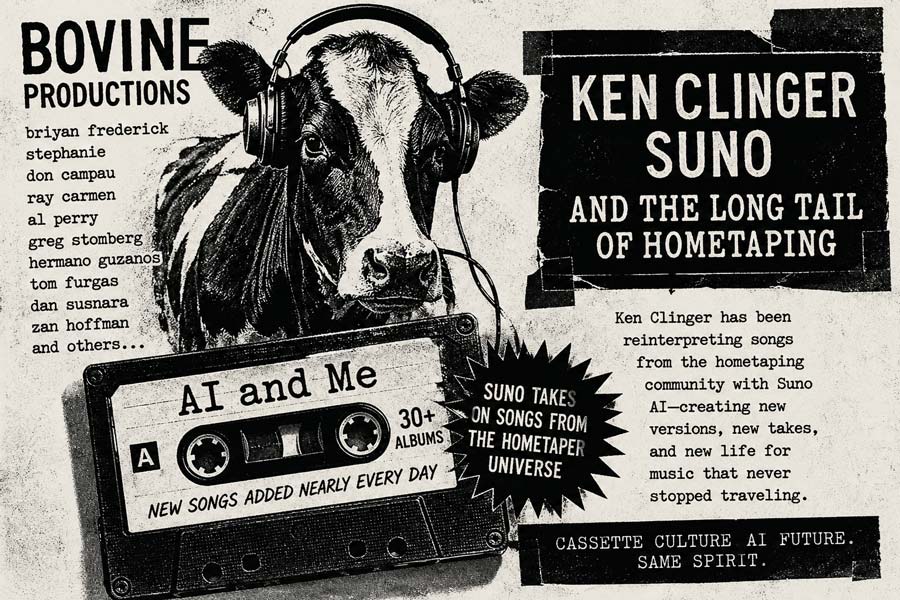
What Ken has been doing over the past year or so is taking songs—mine included—and running them through Suno, not as a novelty, but as an ongoing practice. He’s built a series called AI and Me that now stretches across more than thirty albums, with new tracks appearing almost daily. Looking at the scope of it on his SoundCloud page, it’s hard not to recognize the same kind of persistence and curiosity that defined cassette culture. The volume alone tells you this isn’t casual experimentation. It’s routine. It’s habit. It’s someone showing up and continuing a conversation.
His version of “Birthdays and Breakups” sits right in the middle of that. Hearing it doesn’t feel like listening to a replacement or even a reinterpretation in the traditional sense. It feels more like overhearing a parallel thought—what the song sounds like when it passes through someone else’s sensibility, filtered through a completely different toolset. The structure might be familiar, the lyric intact, but the delivery carries a different weight, a different pacing, a different emotional temperature.
That idea—of songs continuing beyond their original recording—was always baked into hometaping. People covered each other’s material, borrowed ideas, re-recorded fragments, and sent them back out. Nothing stayed fixed for long. A song could live multiple lives depending on who picked it up next. What’s different now is the speed and the scale, but the underlying impulse hasn’t changed much at all.
Ken’s catalog makes that especially clear because he isn’t focusing on just one artist. He’s moving across a wide circle of hometapers—people like Stephanie, Don Campau, Ray Carmen, Al Perry, Greg Stomberg, Hermano Guzanos, Tom Furgas, Dan Susnara, and Zan Hoffman—treating each of their songs as something open-ended. You can see it in the track listings across the AI and Me volumes, where names rotate in and out, reappearing in different contexts, sometimes in alternate versions, sometimes in entirely new interpretations. It reads like a map of the old network, only now the connections are happening in real time instead of through the postal system.
There’s something generous about that approach. Ken isn’t trying to define these songs or pin them down. He’s extending them, giving them another pass through the world. Each version becomes another point of entry, another way for someone to encounter the material. In the cassette days, circulation was everything—the idea that a tape could travel, get dubbed, passed along, and slowly build a life beyond its origin. What Ken is doing feels like a digital continuation of that, where circulation includes transformation as part of the process.
It also raises interesting questions about authorship, though not in a way that needs to be resolved. When I hear his take on one of my songs, I still hear mine in it, but I also hear his decisions layered on top. The phrasing, the feel, the sonic choices—they belong to him in that moment. The song becomes a shared space, something that can hold more than one identity without collapsing into a single “correct” version.
That kind of overlap used to happen all the time, just with different tools. Four-tracks, cassette decks, cheap microphones—limitations that shaped how things sounded. Suno introduces a different set of limitations and possibilities, but the creative act is still about interpretation. You’re still deciding how a song should move, where it should lean, how it should feel when it lands.
What stands out most in Ken’s work is the consistency. Thirty-plus albums under the AI and Me banner, with more being added all the time, suggests a mindset that values process over product. It isn’t about landing on a definitive version of anything. It’s about continuing to engage, continuing to listen, continuing to respond. That rhythm feels familiar in the best way, like the steady exchange that used to define the scene.
Looking through his catalog, you start to see patterns emerge. Artists reappear. Themes echo. Variations stack up. It becomes less about individual tracks and more about the body of work as a whole, the accumulation of responses over time. That was always part of the appeal of hometaping too—the sense that you were watching something evolve in real time, even if the timeline stretched over months or years.
Ken Clinger’s AI and Me series carries that forward into a different era. The tools are new, the distribution is instant, but the core idea remains intact: music as an ongoing exchange between people who are listening closely enough to answer back.
And somewhere in there, between the original recording and the latest reinterpretation, the song keeps moving.