
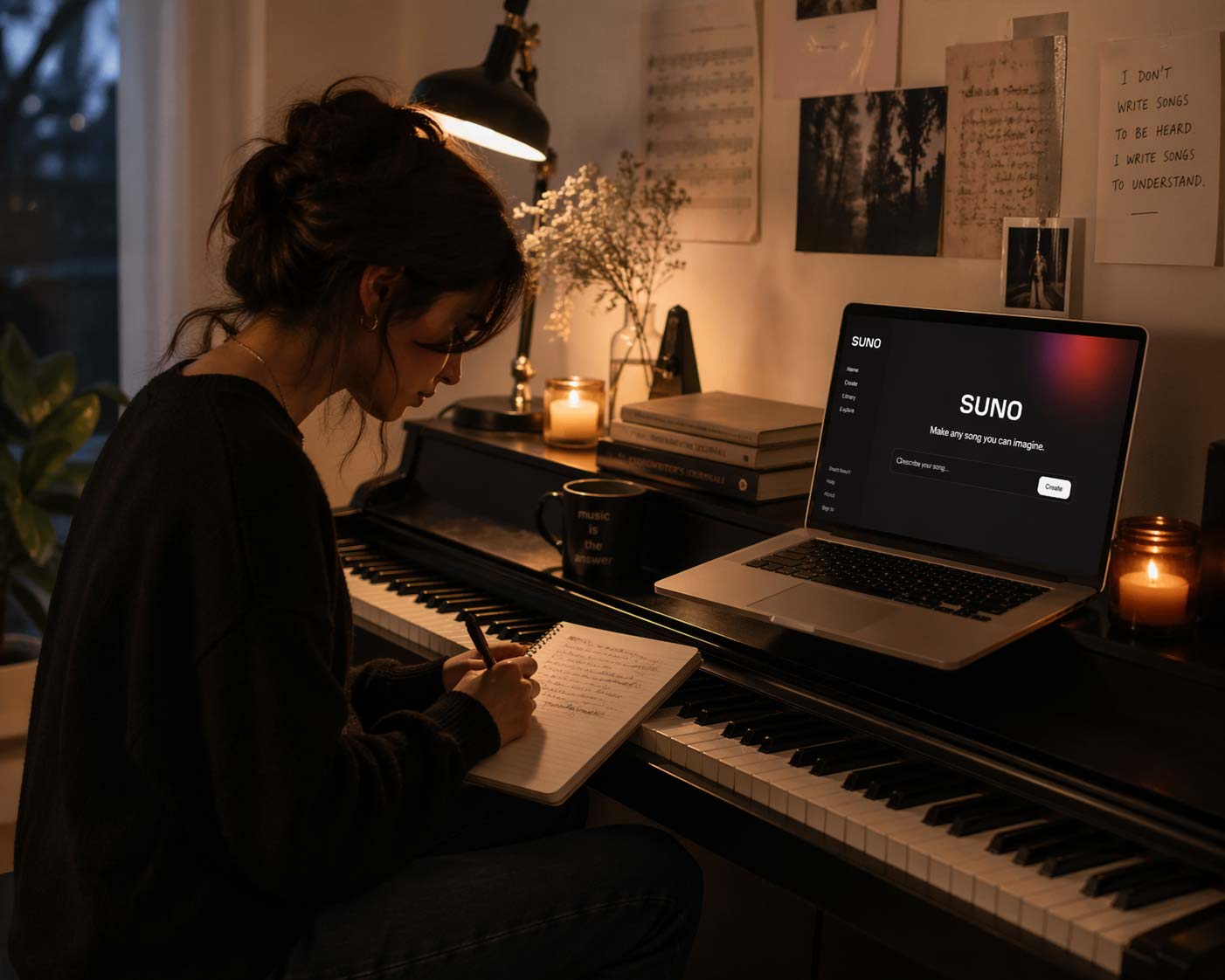
When Music Models Are More Human Than Not
There’s a strange idea floating around right now, one that feels backwards at first glance: that AI-generated music—specifically what comes out of Suno AI—can feel more human than music made by humans themselves.
Sit with that for a second.
It sounds like something designed to provoke, maybe even irritate. Music has always been tied to human expression—breath, touch, imperfection, lived experience. A machine generating something “more human” feels like a category error. And yet, when you listen closely, there’s something going on here that deserves a deeper look.
Not because AI replaces humanity. But because it reflects it in a way that exposes what we sometimes lose.
The Illusion of Perfection
Modern music production has spent decades chasing perfection. Quantized drums. Pitch-corrected vocals. Grid-aligned everything. Even raw performances are often polished until the edges are gone.
The result is technically flawless music that can feel oddly distant.
When everything is controlled, nothing breathes.
What’s interesting about Suno is that it doesn’t approach music the way a trained engineer does. It doesn’t think in terms of “fixing” a take. It generates from patterns—millions of them—absorbing phrasing, emotional arcs, timing inconsistencies, stylistic quirks. And when it outputs a song, it often leans into those imperfections in ways that feel unintentional… because they are.
You’ll hear a vocal stretch a syllable just a bit too long. A phrase lands slightly ahead or behind where you expect it. The structure bends in ways that don’t always follow traditional songwriting rules.
And suddenly, it feels alive.
Flow Over Formula
One of the things I’ve always gravitated toward in songwriting is flow—the way words move, the way a line feels when it lands, regardless of syllable count or structure.
Suno seems to “get” that.
It doesn’t rigidly adhere to meter. It doesn’t stop mid-idea because a line has too many syllables. Instead, it pushes forward, prioritizing momentum over correctness. The result can feel closer to how a human actually writes in a moment of inspiration—messy, intuitive, sometimes uneven, but emotionally coherent.
Ironically, many human writers edit that out.
We tighten. We trim. We reshape until the magic is technically sound.
Suno often leaves the magic in.
Memory Without Experience
Here’s the paradox: Suno has no lived experience. No childhood. No heartbreak. No memories of sitting in a room with a guitar trying to figure out a chord progression.
And yet, it has absorbed the patterns of those experiences from countless human expressions of them.
It’s like a mirror made of echoes.
When it generates a song, it’s pulling from the residue of human emotion embedded in music history. Not a single voice, but a collective one. Not a lived story, but the shape of stories told over and over again.
That can create something that feels deeply familiar—almost uncannily so.
Not because it understands emotion, but because it has mapped its contours.
The Human in the Loop
None of this happens in isolation.
The prompts, the lyrics, the intent—that still comes from a person. From someone sitting there, deciding what they want to say, what mood they’re chasing, what direction they want the sound to move in.
In my own work with Blind Mime Ensemble, I often start with fragments—lines, ideas, bits of recordings, something half-formed. Suno doesn’t replace that process. It extends it. It takes those fragments and pushes them into spaces I might not have reached on my own.
And sometimes, what comes back feels more honest than what I would have constructed deliberately.
Not because it’s “better,” but because it bypasses certain habits. Certain expectations.
It surprises me.
That surprise is a deeply human experience.
The Listener’s Role
There’s another layer to this.
Listeners don’t experience music based on how it was made. They experience it based on how it feels. If a song connects, it connects. If it doesn’t, it doesn’t.
Most people aren’t analyzing whether a vocal came from a human throat or a generated model. They’re responding to tone, phrasing, emotion, familiarity.
If something resonates, the brain fills in the humanity.
We’ve always done this. With synthesized instruments. With sampled sounds. With heavily processed vocals. We project meaning onto sound.
Suno simply gives us a new kind of canvas for that projection.
So… More Human?
Saying AI music is “more human” is probably the wrong framing.
What it does is expose something.
It shows that “human” in music isn’t about origin. It’s about perception. It’s about imperfection, flow, unpredictability, and emotional resonance.
And in a strange twist, a system that doesn’t care about rules can sometimes land closer to those qualities than a human trying very hard to get everything right.
Not always. Not consistently. But often enough to make you pause.
A Shift, Not a Replacement
This isn’t the end of human-made music. It’s a shift in how music can be made, explored, and experienced.
Tools have always shaped art. Tape machines. Synthesizers. DAWs. Sampling. Each one changed the conversation.
Suno is another step in that lineage.
The difference is that this tool doesn’t just extend your hands—it extends your instincts. It collaborates in a way that feels less like operating a machine and more like responding to something that responds back.
And in that exchange, something interesting happens.
You start to hear yourself differently.
Final Thought
Maybe the real takeaway isn’t that AI music is more human.
Maybe it’s that it reminds us what “human” actually sounds like.
Loose edges. Unexpected turns. Emotion over precision. Flow over structure.
The things we sometimes edit out… are the very things that make a song feel alive.
And if a machine can remind us of that, then it’s not replacing us.
It’s holding up a mirror.