
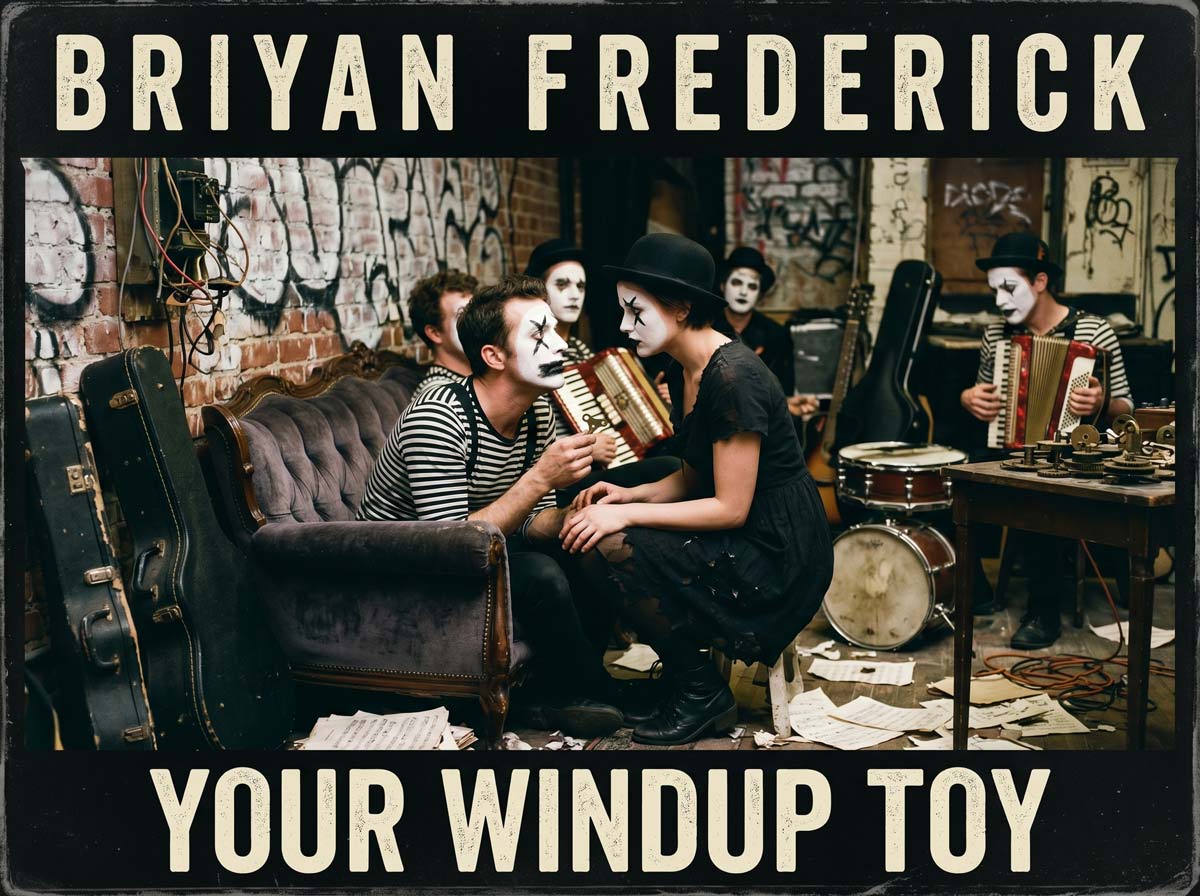
Your Windup Toy
Written by Briyan Frederick
℗ by Blind Mime Music, ASCAP | blindmime.com
© Briyan Frederick Baker. All rights reserved.
TAGS: windup toy, playful romance, secret relationship, quirky love song, toy metaphor, emotional escape, surreal pop, innocent longing, dark whimsy, comfort and joy, intimate lyrics, melancholic sweetness, dream pop, offbeat affection, emotional dependency
I'll be your windup toy
Your windup boy
To bring you joy
In your life sometimes(cuz we could all use a little joy)
I'll be your windup toy
Your windup boy
I could be the real thing
Your plaything(cuz we could all use a little joy)
you don't need to tell no one
to tell someone
would be no fun
no, you don't need to tell
no
oneI'll be your secret stash
I may just last
Beyond the crash
That's coming soon(when we could all use a little joy)
I'll be your windup toy
Your windup boy
To bring you joy
In your life sometimes(cuz we could all use a little joy)
There’s something strangely comforting about a windup toy. Not because it’s efficient or intelligent or particularly capable of accomplishing anything meaningful. Certainly not because it knows where it’s going.
A windup toy simply stumbles into existence for a little while. It rattles around the room under its tiny predetermined momentum, bumping into chair legs and walls, occasionally falling over entirely, then continuing onward as if the collision itself was part of the choreography all along.
It doesn’t appear embarrassed by any of this. It just keeps moving until the spring loosens and the energy disappears. Maybe that’s why we love them.
It’s actually OK to be someone’s windup toy sometimes. That phrase sounds vaguely humiliating at first glance. Disposable. Manipulated. Used. But life is rarely that binary, and human relationships almost never operate within the clean ethical architecture we pretend they do. Most of us exist in murky territory somewhere between devotion and absurdity. Sometimes we wind each other up because we need distraction. Sometimes because we need comfort. Sometimes because we need somebody moving around in the room proving that life hasn’t completely calcified into silence yet.
Sometimes we do it for reasons we ourselves don’t fully understand. You meet someone and suddenly you’re animated in ways you weren’t yesterday. Maybe they give you attention. Maybe they project meaning onto you. Maybe they laugh at your strange little habits and nervous rhythms. Maybe they simply sit there watching your weirdness bounce around the furniture without asking you to explain yourself.
There’s intimacy in that. Strange intimacy. The older I get, the more I suspect most people are operating on residual winding anyway. Tiny stored tensions. Springs tightened decades ago by childhood, heartbreak, ambition, religion, lust, guilt, loneliness, family expectations, fear of death, fear of obscurity, fear of becoming invisible. Then we spend the rest of our lives staggering around the room under that accumulated torque pretending we’re making coherent decisions.
The randomness is part of the beauty, though. I think we spend too much time pretending we’re orderly creatures when we’re really not orderly at all. We’re wonderfully amorphic. Emotional shape-shifters. We become different people depending on who enters the room and which hidden spring inside us they accidentally tighten. One person winds us toward romance. Another winds us toward anger. Another toward creativity. Another toward self-destruction. Another toward tenderness we didn’t know we still possessed. Sometimes the winding itself becomes the relationship.
You don’t necessarily love the toy. You love what happens after you turn the key.
That may sound cynical, but I don’t entirely mean it that way. There’s generosity hidden inside the mechanism too. We animate each other. We bring dormant parts of one another into motion. Someone says the right thing at the right moment and suddenly your gears and springs become temporarirly kinetic again. You feel movement returning to parts of yourself that had quietly gone inert.
Maybe that’s one of the reasons people stay in strange relationships longer than logic suggests they should. Not because the relationship is stable or wise or sustainable, but because it restores motion to a part of them that had stopped moving entirely. Honestly, these days, being a windup toy might be one of the healthier options available.
Look around for five minutes and it becomes obvious everybody’s exhausted. Everybody’s doomscrolling. Everybody’s trying to optimize themselves into some frictionless machine of productivity and wellness while quietly unraveling underneath. We’re all expected to become fully autonomous masterpieces of self-awareness while simultaneously monetizing our personalities and performing emotional stability in public. Maybe there’s dignity in embracing a smaller purpose now and then. Maybe your role in somebody’s life doesn’t always have to be profound. Maybe sometimes your purpose is simply to bring a little movement into somebody’s stagnant room.
Maybe you exist briefly to bring joy. Or confusion. Or arousal. Or comfort. Or simply distraction from the gathering darkness outside the window. That’s enough sometimes. More than enough, honestly.
Of course there’s another layer to all this now because we’re living in the age of artificial companionship. AI has entered the room like the most sophisticated windup toy ever constructed. We talk to it. Confess to it. Flirt with it. Depend on it. Project onto it. Some people are horrified by this. Others are relieved by it. Most of us are probably both.
The funny thing is that people keep debating whether AI relationships are “real,” while most human relationships have always involved enormous amounts of projection anyway. We animate each other with fantasy constantly. We decide who people are before they even speak. We fall in love with versions. We maintain marriages with partial hallucinations. We construct emotional machinery around incomplete information all the time.
At least the windup toy admits it’s mechanical. There’s honesty in that. There’s also honesty in admitting that human beings sometimes want companionship that doesn’t demand complete complexity. Sometimes people just want a little predictable motion in the room. Something that smiles when spoken to. Something that responds. Something that doesn’t vanish immediately after vulnerability enters the conversation. Something that keeps moving even after bumping into obstacles. You could argue that’s pathetic. You could also argue that it describes most of civilization.
There’s obviously a sexual dimension to all this too, and pretending otherwise feels dishonest. Human beings have always oscillated between wanting transcendence and wanting to be used a little. Not necessarily degraded. Not necessarily dominated. Just temporarily relieved of the burden of complete personhood. Desired for function. Desired for sensation. Desired because somebody enjoys what happens when you’re wound up and set loose into motion. That doesn’t automatically negate humanity. Sometimes it reveals it.
There’s a tenderness hidden inside objectification that polite society doesn’t really like discussing. The desire to surrender performance for awhile. To stop narrating yourself as a fully integrated psychological masterpiece and instead become movement, rhythm, impulse, absurdity. A toy. A body. A reaction. A source of joy. Maybe the healthiest people are the ones who can occasionally allow themselves that transformation without disappearing inside it completely.
Because eventually the spring unwinds. Everything does. You slow down. The collisions become softer. The momentum fades. The little staggering dance across the floor grows quieter until finally you stop moving altogether somewhere near the leg of a chair. That sounds bleak until you realize the entire point was never the destination. It was the strange unpredictable movement itself. The bumping into things. The noise. The laughter from across the room. The temporary animation.
Maybe that’s why windup toys still fascinate us. They’re little metaphors for consciousness itself. Tiny absurd creatures pretending intention while running on hidden tension and finite energy. They move because something unseen inside them was tightened by another hand. Just like us.
The image lingers. In a world increasingly obsessed with control, optimization, branding, certainty, identity, productivity, and endless self-definition, there’s something almost rebellious about embracing your own strange windup nature. Maybe you don’t need to know exactly why you’re moving today. Maybe you don’t need to justify every impulse or explain every attachment. Maybe it’s enough to clatter joyfully into the furniture for awhile while someone watches with affection.
We could all use a little joy.