
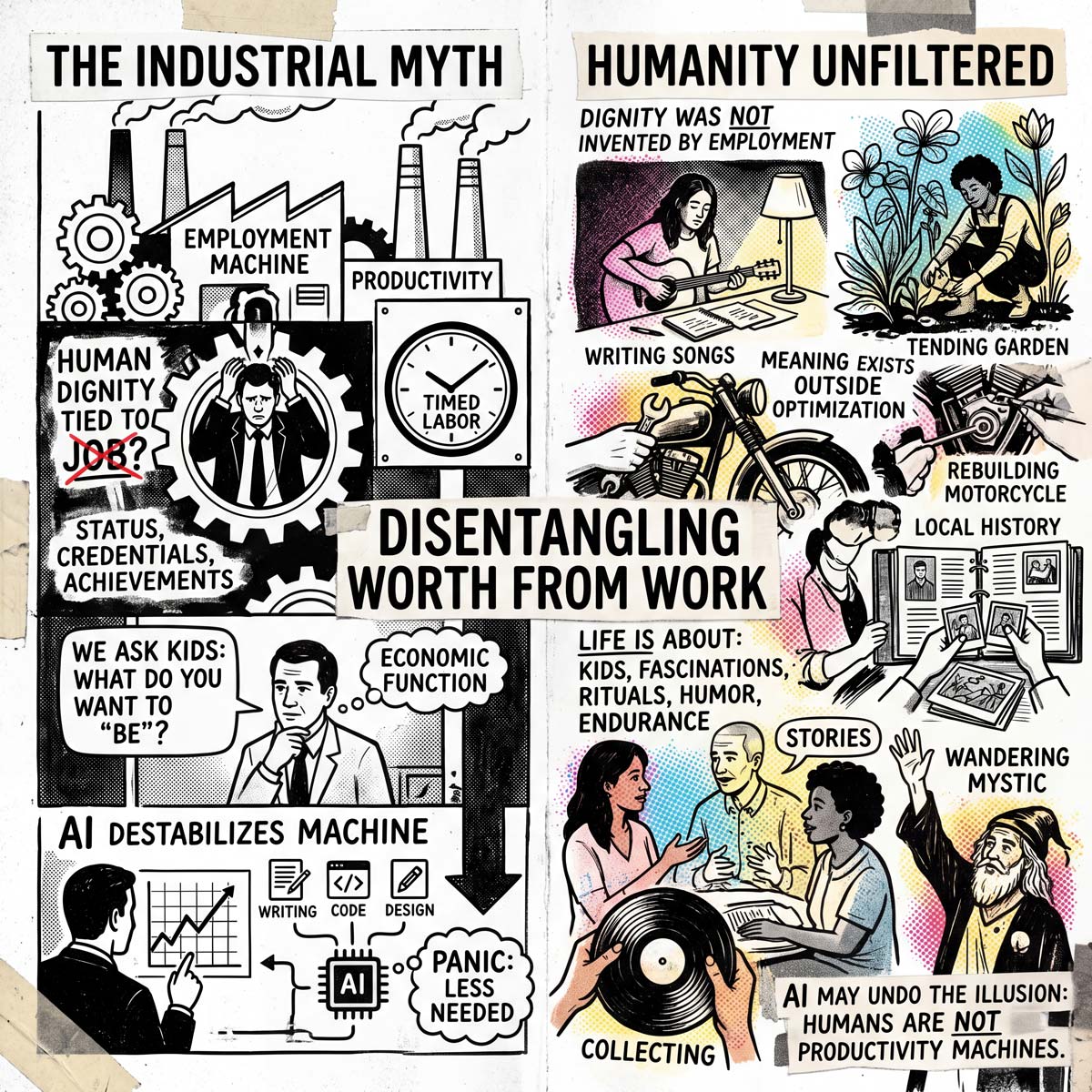
The Industrial Lie About Human Worth
One of the strangest assumptions of modern life is that human dignity is fundamentally tied to employment. Not contribution in the broad human sense. Not participation in life. Not care, memory, curiosity, humor, endurance, creativity, or wisdom. Employment. A job. Preferably one that can be measured, categorized, optimized, monetized, and taxed.
This idea is so deeply embedded in the culture that people rarely stop to examine it closely. We ask children what they want to “be” when they grow up, but what we usually mean is: what role will you occupy inside the economic machine?
We ask adults, “What do you do?” and the expected answer is almost never about music, collecting records, building strange little worlds in the garage, preserving local history, tending gardens, or staying awake until 2 a.m. discussing philosophy online. We mean employment. We mean economic function. We mean the role assigned inside the system.
But I suspect most people do not actually experience themselves this way. The assumption that they do may itself be a kind of elite projection. Professional-managerial culture often revolves around career identity because status in those circles is tightly coupled to credentials, institutional affiliation, achievement, and productivity. Entire social hierarchies are built around titles, resumes, networking, and measurable success. In those environments, work and identity genuinely blur together because the system rewards people for allowing that fusion to happen.
Outside that framework, life is usually understood much differently. The warehouse worker who writes songs every night may see the warehouse as merely the thing funding the real life. The grandmother tending tomatoes in the backyard may derive more meaning from that tiny ritual than from forty years of payroll administration. The guy rebuilding an old motorcycle in the garage after work is not escaping life. He may be returning to it. The woman carefully documenting local history in binders and scanned photographs may be contributing something more culturally valuable than entire departments devoted to maximizing quarterly efficiencies.
Most people I’ve known are not ultimately about their jobs. They are about their kids, their relationships, their strange fascinations, their rituals, their memories, their obsessions, their communities, their hobbies, their private worlds, their grief, their humor, their music, and their stories. The job is infrastructure. Sometimes necessary infrastructure. Sometimes oppressive infrastructure. But still infrastructure.
This becomes increasingly obvious as AI enters the picture. The industrial era tied human worth to labor partly because industrial society required enormous coordinated human effort. Factories, offices, logistics chains, manufacturing systems, customer service operations, accounting departments, and administrative structures all depended on masses of people performing repetitive cognitive or physical tasks. Employment became not merely a way to distribute resources, but a social organizing principle. Time itself became segmented around work. Identity became fused with usefulness because industrial economies required synchronized productivity on a massive scale.
Now AI destabilizes that arrangement. Not because machines suddenly become conscious overlords, but because cognition itself is becoming cheap. Writing, coding, illustration, legal drafting, advertising copy, design, translation, research, music production, and customer service are all being partially automated. One person equipped with AI tools can now generate what once required entire teams. The marginal cost of producing many forms of intellectual labor is collapsing in real time.
That creates a profound contradiction. The modern economy still distributes survival through employment, but AI increasingly reduces the amount of human labor required to generate economic output. Productivity rises while the human role inside production shrinks. Wealth accumulates, but participation becomes less necessary. The system begins quietly severing the relationship between labor and value while still pretending the old rules remain intact.
This is where panic enters the conversation. Some people immediately conclude that if human labor loses economic centrality, people will lose dignity. But this conclusion may reveal more about industrial assumptions than about human beings themselves. The fear assumes that meaning originates from economic usefulness rather than from participation in life itself.
Dignity was not invented by employment.
For most of human history, people found meaning through family, ritual, storytelling, craftsmanship, religion, local reputation, survival, care for others, music, friendship, seasonal rhythms, and participation in communal life. A medieval villager did not define his essence through quarterly productivity metrics. A grandmother feeding grandchildren was not considered worthless because she lacked a professional identity. The storyteller, eccentric musician, wandering mystic, local craftsman, or village historian often occupied meaningful cultural positions that had little relationship to industrial productivity.
Modern capitalism narrowed worth into productivity because productivity was the fuel source of industrial expansion. Factories needed labor. Corporations needed labor. Expanding economies required masses of disciplined workers whose time could be synchronized and measured. Over time, economic necessity gradually transformed into moral philosophy. Productivity stopped being merely useful and became virtuous. Employment stopped being a practical arrangement and became intertwined with identity itself.
But many people have always quietly resisted this reduction. Artists know it. Musicians know it. Zinesters know it. Collectors know it. Retired people often rediscover it after decades inside work structures. Teenagers understand it instinctively before adulthood teaches them to suppress it. Anyone who has stayed awake late into the night creating something nobody asked for already understands that meaning frequently exists outside optimization.
The things that make life feel alive are often the least economically efficient. Long conversations. Making strange music in a basement. Preserving obscure cultural artifacts. Starting tiny scenes. Driving nowhere with a friend. Recording tapes no one may ever hear. Cooking for people you love. Collecting fragments of memory. Building communities around bizarre shared fascinations. Watching old movies. Writing things with no obvious market value. Sitting quietly with someone in grief.
None of these activities fit neatly into GDP models, but they may be closer to actual civilization than large portions of modern economic activity. Human beings remember songs, gestures, conversations, and relationships long after they forget organizational charts and productivity metrics. Nobody lies awake near death reminiscing about efficiently answered emails.
AI may force society to confront this directly. Not because everyone suddenly stops working tomorrow. The physical world still exists. Food must still be grown. Infrastructure still requires maintenance. Elder care cannot be entirely abstracted into software. The material world continues demanding participation regardless of how advanced digital systems become.
But the ratio changes. If fewer human labor hours are required overall, then societies eventually face an uncomfortable choice. Either human beings are treated as economically obsolete, or societies begin disentangling survival and dignity from labor markets.
Many ordinary people may already be emotionally prepared for this disentanglement in ways elites are not because they never fully believed the industrial story to begin with. The person making experimental music at midnight after an exhausting shift already understands something important. Life was never fully contained inside employment. The real self often existed elsewhere all along, waiting beneath obligations, surviving underneath schedules, quietly preserving itself in hobbies, relationships, rituals, and acts of creation that had nothing to do with market efficiency.
The coming AI era may not create that realization. It may simply expose what was always true. Human beings were never machines for productivity alone. They were always storytellers, caretakers, wanderers, creators, collectors, lovers, archivists, dreamers, and participants in experiences far larger than economics.
The industrial age temporarily convinced society otherwise. AI may accidentally undo that illusion.