
From Tapegerm to End of the World Plugins: Keith Hanlon’s Long Road Through Sonic Exploration
If you knew Keith Hanlon during the early days of Tapegerm in the 2000s, none of this feels surprising.
Back then, Tapegerm was built around unfinished ideas, loops, fragments, found sounds, and recordings passed between strangers and collaborators who would reshape them into something new. It rewarded curiosity more than perfection. Keith’s contributions fit naturally into that ecosystem because sonic exploration wasn’t something he occasionally did — it was simply how he approached sound.
That same mindset runs through End of the World Plugins.
These aren’t plugins built around chasing trends or recreating the same tools already filling plugin folders everywhere. They feel designed by someone who has spent years asking, “What happens if I push this a little further?”
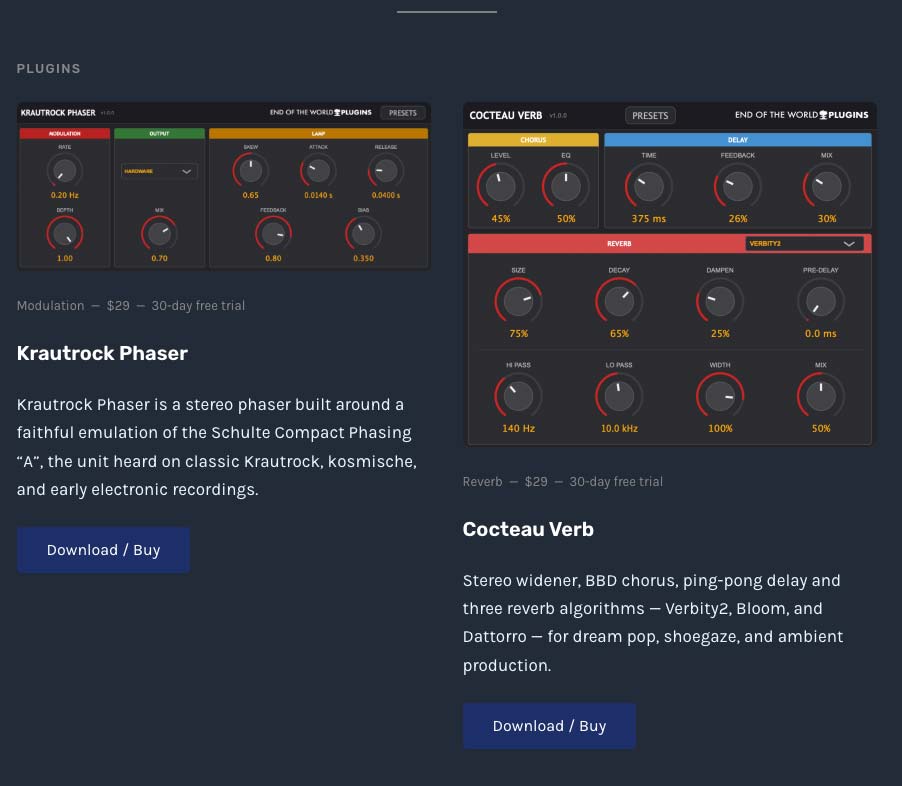
Krautrock Phaser immediately signals those intentions. Built around the classic Schulte Compact Phasing “A,” it captures the hypnotic movement associated with kosmische music, experimental rock, and early electronic recordings, but more importantly, it invites repetition and drift. Good phasers create motion. Great phasers create altered states. This one leans toward the latter, turning static loops, guitars, synths, and percussion into evolving textures that feel alive.
Cocteau Verb expands the palette further. Calling it simply a reverb undersells what’s happening here. Between stereo widening, chorus, delay, and multiple reverb algorithms, it becomes less of an effect and more of an environment builder. Shoegaze and dream pop are obvious landing spots, but the plugin feels equally comfortable creating unstable ambience, exaggerated spaces, and sounds that seem partially dissolved at the edges.
Then there’s FM Radio Compressor, the free entry in the lineup, which approaches dynamics from a broadcast mindset. “It makes the quiet louder” sounds simple because it is. Sometimes useful tools are. With lookahead compression, program-dependent release, and switchable metering, it delivers density and presence without unnecessary complexity.
What ties these plugins together isn’t merely their feature sets. It’s a design philosophy rooted in experimentation. They feel like tools created by somebody who spent years manipulating tape loops, swapping audio fragments online, processing found sounds, and learning that accidents are often more interesting than intentions.
For longtime Tapegerm participants, there’s something familiar here. Not nostalgia exactly. More like seeing an old impulse continue evolving decades later into software built for musicians who still believe exploration matters.
This version centers Keith, Tapegerm history, and the idea that these plugins come from a long lineage of experimentation rather than appearing out of nowhere.