
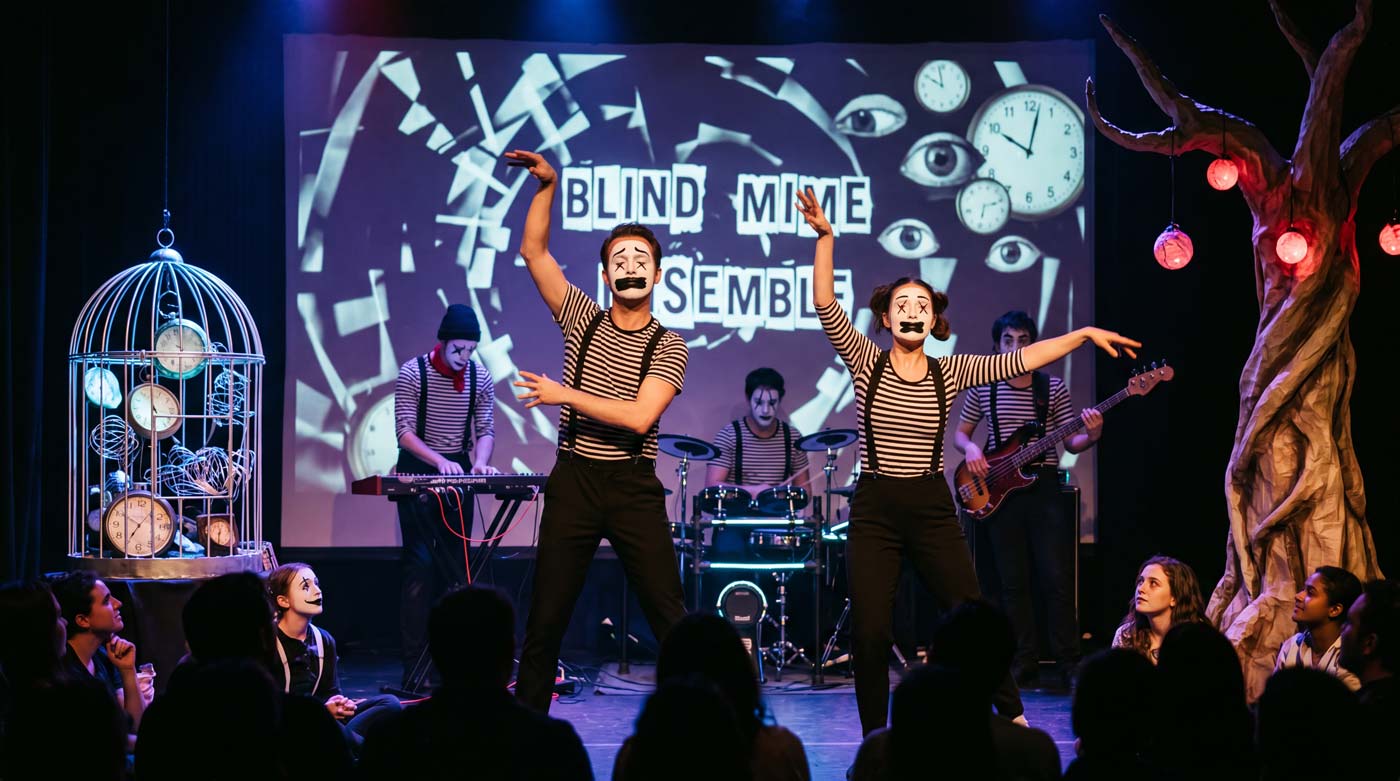
"Thanks for Coming": Inviting You Inside the Mind of a Blind Mime
The story behind the opening track of Collection 22
Every album has to start somewhere, and "Thanks for Coming" is the song I keep coming back to as a doorway. It's the first track on Collection 22, and it's also the lead-off number for a show I've been building in my head for the better part of forty years — the Blind Mime Ensemble. So before I tell you how this one got made, I should probably tell you about the mimes.
Two mimes who can't see and can't speak
The Blind Mime Ensemble is a name I've carried around since I was young, and it has slowly turned into something bigger than a band name. I think of it as a piece of performance art — eventually a series of theater shows — fronted by two blind mimes, one male and one female. There's a deliberate absurdity in that image, and I love it. A mime already refuses to speak. Make that mime blind, and you've got a performer who can neither see their audience nor talk to them, yet still stands on a stage trying with everything they have to communicate. That's not a joke to me. That's all of us. The blind mime is my metaphor for how hard it actually is for human beings to reach one another — how much we gesture and perform and hope something lands, never quite sure the other person is receiving what we're sending.
Collection 22 gathers my most recent songs, and almost without my planning it, they ended up circling the same territory: battles of the mind and the psyche, the war we wage inside our own heads. "Thanks for Coming" opens that collection because it sets the whole frame. It welcomes you in — and then it asks you whether you really want to come where I'm about to take you.
A song that started as a title
Here's a detail I love about this one: I didn't choose the title. It was handed to me. "Thanks for Coming" came out of a Songfight.net challenge around 2003. If you've never run across Songfight, the premise is beautifully simple and a little terrifying — everyone is given the same song title, and you've got about a week to write and record a complete song around it. No melody, no theme, no head start. Just two words and a deadline, and whatever your imagination does with them under pressure.
I find that constraint enormously freeing. When a title arrives from the outside, you can't overthink your way into the "right" idea, because there isn't one yet — you have to commit fast and trust your instincts. "Thanks for Coming" is the kind of phrase a host says, an emcee's throwaway line, and my mind immediately ran to the stage: a performer greeting a crowd. That's where the blind mime walked in. The whole song is essentially what happens when you take a polite, hospitable little phrase and ask what it would really mean for a performer to say it and mean it — to genuinely thank you for showing up, and then dare you to actually be present.
I recorded it at home, entirely solo, on a MacBook running BIAS Deck II. Every part is me: piano, guitars, bass, drums, synthesizers, and vocals. There's a particular intimacy to making a record completely alone in a room on a one-week clock — nobody to perform for while you're tracking, so the only honesty available is whatever you're willing to commit to the session. Looking back, I think that solitude is exactly why a song about the difficulty of connection came out the way it did. I was, quite literally, a person alone trying to send a signal out to whoever might eventually hear it.
What the lyric is really doing
On the surface, "Thanks for Coming" sounds like a host warming up a crowd: Sit back, enjoy the show. Relax and let yourself go. It's gracious, almost cabaret. But that warmth is a setup. The very next breath is a dare:
Do you really want to see / What a blind mime sees? Do you really want to know / What a blind mime has to show?
That's the hinge of the entire song. A blind mime "sees" nothing in the ordinary sense and "shows" nothing in words — so the question is really are you willing to look past the performance and find the person? When the lyric pushes further — What's underneath your clothes? What's underneath your nose? — it isn't being coy. It's turning the question back on the listener. This isn't only my unveiling. It's an invitation for you to drop your own act too.
Then the song extends a literal hand: Come on and take my hand, I want to show you some things buried deep inside of me, locked away until tonight. Come and turn the magic key. That's the most vulnerable moment in the piece — the performer admitting there's a locked interior, and that tonight, with this audience, is the one chance to open it. The "magic key" is simply attention. Genuine attention from another person is the only thing that ever unlocks anybody.
The climax says the quiet part out loud: Disregard the pantomime, come and step inside my mind. Forget the costume, forget the gestures, the mime is begging you to ignore the act and go straight to the consciousness behind it. And then the song fixates — 'cos now's the time, now is the time — repeated until it stops being a lyric and becomes a heartbeat. Communication, if it's going to happen at all, has to happen now, in this fleeting moment of contact, before the curtain comes down and we all retreat behind our masks again.
How the music carries it
The version that opens Collection 22 isn't the raw 2003 file — it's a remake. I took the original home recording and reworked it through Suno, letting that reimagining push the song into fuller territory than my MacBook session ever reached. The result lands as indie progressive electronic rock, running about three minutes and forty-three seconds, and it's a strange, satisfying thing to hear a song you built alone in a room over a single week come back two decades later with new dimensions. What I'm most proud of is the shape of it. It opens at a confident, welcoming level — that "sit back, enjoy the show" energy — and rather than spending everything early, it keeps gathering. The middle stretch builds steadily, layer over layer, and the song swells to its fullest, brightest peak right as those "now's the time" chants stack up. The most intense moment of the recording is also the most emotionally exposed moment of the words. Then it releases and resolves, like a held breath finally let go. That arc isn't decoration; it's the argument. The music insists on urgency at exactly the point the lyric demands you step inside.
That's the whole trick of "Thanks for Coming," really. It thanks you for showing up, flatters you a little, and then quietly asks whether you have the nerve to actually be present — to disregard the pantomime and meet a blind mime in the dark. Not bad for two words handed out on a Tuesday. If you take the dare, the rest of Collection 22 is waiting on the other side of that door.
Thanks for coming. Now's the time.